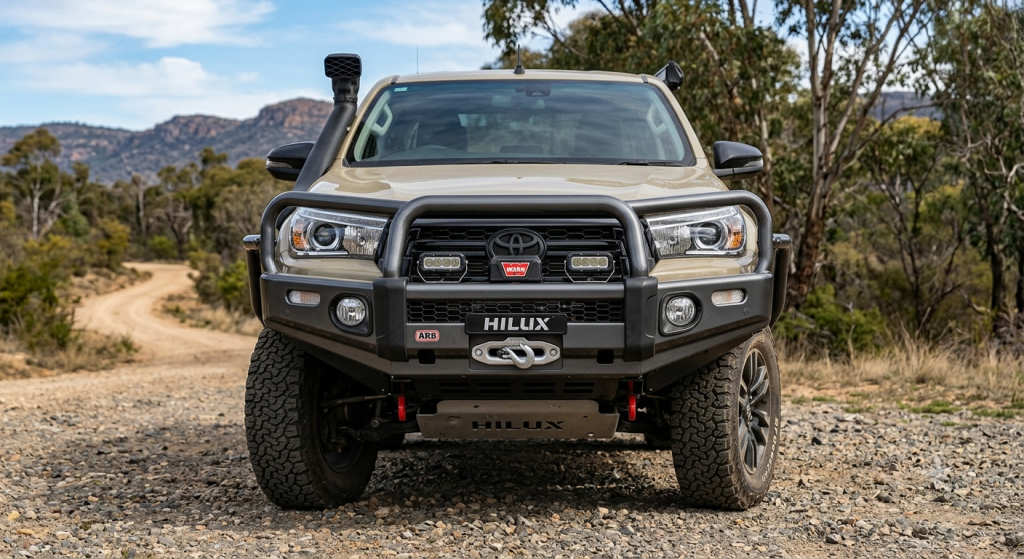
Are steel bull bars legal australia–wide? Yes, steel bull bars are legal in Australia, provided they strictly comply with Australian Design Rules (ADR), Australian Standard AS 4876.1-2002, and state road transport regulations.
If you drive a four-wheel drive across rural highways, Outback tracks, or regional timber routes, fitting a heavy-duty steel bar is one of the most effective ways to protect your radiator, engine bay, and occupants against animal strikes. However, installing an unapproved, custom-welded, or non-compliant steel bull bar can result in costly defect notices, insurance claim rejections, and severe safety compromises.
In this comprehensive guide, we unpack every legal requirement you must know to ensure your 4×4 frontal protection setup stays 100% road-legal across every Australian state and territory.
When offroaders ask are steel bull bars legal australia-wide under federal legislation, the answer comes down to three primary technical standards:
Modern 4WD vehicles use complex crumple zones and sensitive frontal crash sensors to trigger Supplementary Restraint System (SRS) airbags during an impact. Under ADR 69/00 (Full Frontal Impact Occupant Protection) and ADR 73/00 (Offset Frontal Impact Occupant Protection), any aftermarket frontal protection structure must not interfere with the vehicle’s original crash pulse dynamics or delay airbag deployment.
A legally manufactured steel bull bar features engineered chassis brackets with built-in crumple accordion zones. These brackets absorb minor impacts while ensuring the deceleration forces in a high-speed crash trigger the vehicle’s SRS airbags exactly as the vehicle manufacturer intended.
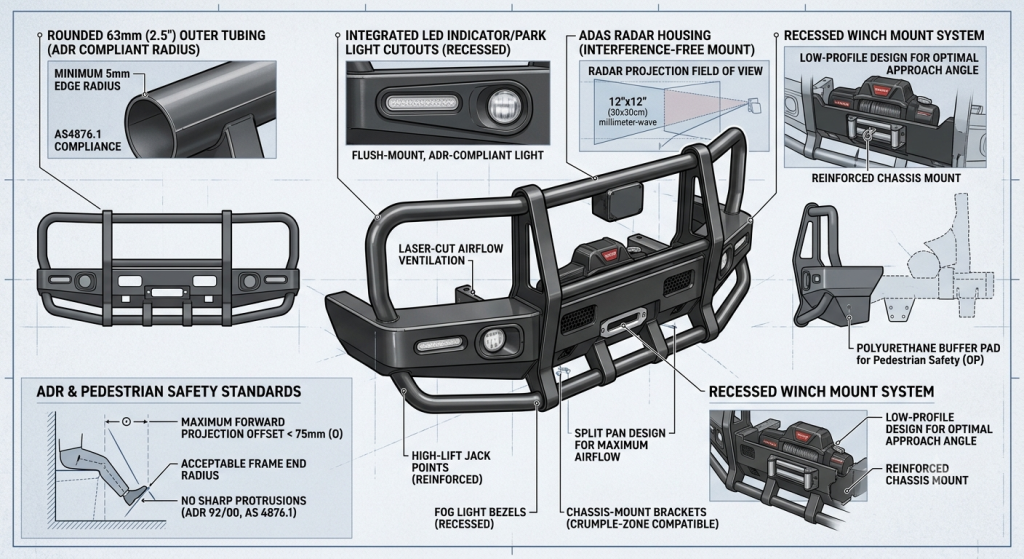
AS 4876.1-2002 is the national specification for Vehicle Frontal Protection Systems (VFPS). It governs physical shape, profile, and pedestrian safety requirements. Key design criteria include:
Administered under the National Code of Practice for Light Vehicle Construction and Modification, VSB 14 sets clear standards for aftermarket light vehicle accessories. VSB 14 states that any modification must maintain the vehicle’s original road safety baseline and structural integrity.
Even if a steel bar is ADR tested, improper installation or mounting forward-facing accessories can instantly render your setup illegal. When evaluating are steel bull bars legal australia transport officers inspect these specific physical parameters:
| Visual & Physical Check | Road-Legal Specification | Non-Compliant / Unlawful Violation |
| Driver Field of View | The driver must have an unobstructed view of the road surface 11 meters forward from the eye position. | High top hoops, oversized light bars, or tall antennas blocking forward sightlines. |
| Forward Protrusions | Winches, driving lights, and brackets must sit completely behind the front face of the bar. | Spotlights or sharp metal brackets projecting forward past the bar’s leading edge. |
| Number Plate Visibility | The front registration plate must be clearly visible from 20 meters away at various angles and under 1.3 meters high. | Number plates obscured by winch fairleads, recovery hooks, or light bars. |
| Lighting Performance | Factory headlights, turn indicators, and parkers must remain fully visible from required viewing arcs. | Solid steel wings blocking factory indicator or headlight lenses. |
| Overall Vehicle Width | Bar wings must wrap cleanly into the wheel arches without extending past side flares. | Overly wide commercial bars protruding past tire lines. |
Modern 4WDs—such as the Ford Ranger Next-Gen, Toyota Landcruiser 300 Series, Isuzu D-Max, and Toyota HiLux—come equipped with Advanced Driver Assistance Systems (ADAS). These systems rely on forward-facing radar units, camera arrays, and ultrasonic parking sensors for:
So, are steel bull bars legal australia on ADAS-equipped 4WDs? Yes, but only if the bar includes certified ADAS sensor relocation housing and radar cutouts.
If a steel bull bar blocks or misaligns an AEB radar sensor, the safety system may trigger false emergency braking at highway speeds or fail entirely during a hazard event. Reputable steel bar manufacturers spend hundreds of hours testing radar recalibration to ensure all factory safety technology operates seamlessly post-installation.
A common reason four-wheel drivers receive defect notices is not the steel bar itself, but the illegal accessories attached to it.
Forward-facing fishing rod holders mounted to the front of a bull bar are strictly illegal across Australia while driving on public roads. Because they represent sharp forward protrusions, they pose severe injury hazards to pedestrians in a collision. Removable rod holders may only be attached when stationary or off-road, and must be unbolted before entering public road networks.
When mounting driving lights or LED light bars to your steel frontal protection system:
If you fit an electric recovery winch, the winch body must sit recessed inside the steel bar cradle. Unprotected winch hooks hanging loosely off the front face create a protruding hazard. Always secure your hook flush against the fairlead or fit a rubber isolator behind the front profile.
Four-wheel drivers often debate whether material plays a role when asking are steel bull bars legal australia-wide.
       [ Frontal Protection System Materials ]
                          │
         ┌────────────────┼────────────────┐
         ▼                ▼                ▼
     [ Steel ]      [ Aluminium ]      [ Polymer ]
  • Heavy-Duty    • Lightweight      • Flexible
  • High Impact   • Corrosion Resistant • High Pedestrian
  • Max Strength  • Lower Payload    Safety Rating
Material choice does NOT dictate legality. Steel, aluminium, and alloy/polymer bars are all 100% legal in Australia provided the specific model passes ADR certification for your vehicle model.
While ADRs provide national guidelines, enforcement is handled individually by state and territory road transport authorities. Here is how state guidelines align when answering are steel bull bars legal australia-wide:
In NSW, vehicle modifications must comply with Vehicle Standards Order (VSO) guidelines and VSB 14. Police officers routinely check for forward protrusions, sharp fishing rod holders, and light bars extending above top hoops. Non-compliant bars will trigger a major defect notice (red slip).
VicRoads publishes guidelines under Transport Victoria VSI 1 Bull Bars Standard. Victoria enforces strict limits on forward offset (maximum 75mm/9 degrees forward tilt) and mandates clear driver vision over the bonnet line.
Queensland TMR allows heavy-duty steel bars for rural and regional driving, but strictly enforces headlight/indicator visibility and number plate placement angles.
Given the vast travel distances in WA, steel frontal protection is widely used. WA DoT enforces compliance with AS 4876.1-2002. Commercial 4WDs and farm vehicles must still adhere to airbag compatibility rules if driven on public roads.
If you install an uncertified, home-made, or non-compliant steel bar, you face major legal and financial consequences:
  [ Non-Compliant Steel Bar Installed ]
                   │
  ┌────────────────┼────────────────┐
  ▼                ▼                ▼
[ Defect Fine ]  [ Invalidated ]  [ Airbag Failure / ]
[  & Canary   ]  [  Insurance  ]  [   Severe Injury  ]
Highway patrol officers can issue an instant defect notice (canary). You will be required to remove the non-compliant bar, submit your vehicle for a roadworthy re-inspection at an authorized station, and pay monetary fines.
Insurance policies contain explicit clauses requiring vehicles to remain fully roadworthy under state law. If you get into a collision and an insurance assessor discovers that an uncertified steel bar contributed to structural damage, delayed airbag deployment, or excessive third-party damage, your insurer can legally deny your entire claim.
If a non-compliant bar with sharp edges or illegal forward projections causes severe injury to a pedestrian or another motorist, you may face personal civil liability or criminal charges for driving an unroadworthy vehicle.
Before investing in a steel frontal protection system for your 4WD ute or SUV, run through this simple verification checklist:
To wrap up the core question—are steel bull bars legal australia-wide? Yes, provided you purchase an ADR-tested, airbag-compatible bar that adheres to AS 4876.1 specifications and VSB 14 guidelines. By selecting a certified bar, avoiding forward-facing protrusions, and ensuring all ADAS sensors are correctly integrated, you can enjoy maximum outback protection with complete peace of mind on Australian roads.
If you have questions about vehicle payload limits, ADR compliance, or selecting the right steel frontal protection bar for your 4×4, contact our expert team at All Model 4×4 Spares. We are here to help you build a safe, fully road-legal touring vehicle!