Commercial Bull Bars vs Offroad Bull Bars: What’s the Difference?
When equipping a 4WD for Australian conditions—whether for fleet operations, agriculture, weekend touring, or technical rock crawling—choosing between a commercial vs offroad bull bar is one of the most critical fitment decisions you will make. While both styles protect your vehicle’s engine bay against destructive wildlife strikes and trail debris, their design priorities, physical profiles, and functional features differ significantly.
Understanding the distinction between a commercial vs offroad bull bar setup prevents you from buying a front bar that compromises your vehicle’s offroad approach angles, overloads your front suspension, or lacks essential mounting features for winches and driving lights.
This detailed guide breaks down every aspect of a commercial vs offroad bull bar comparison, evaluating construction materials, weight distribution, approach clearance, winch mounting, ADAS sensor compatibility, and Australian Design Rules (ADR) legality.
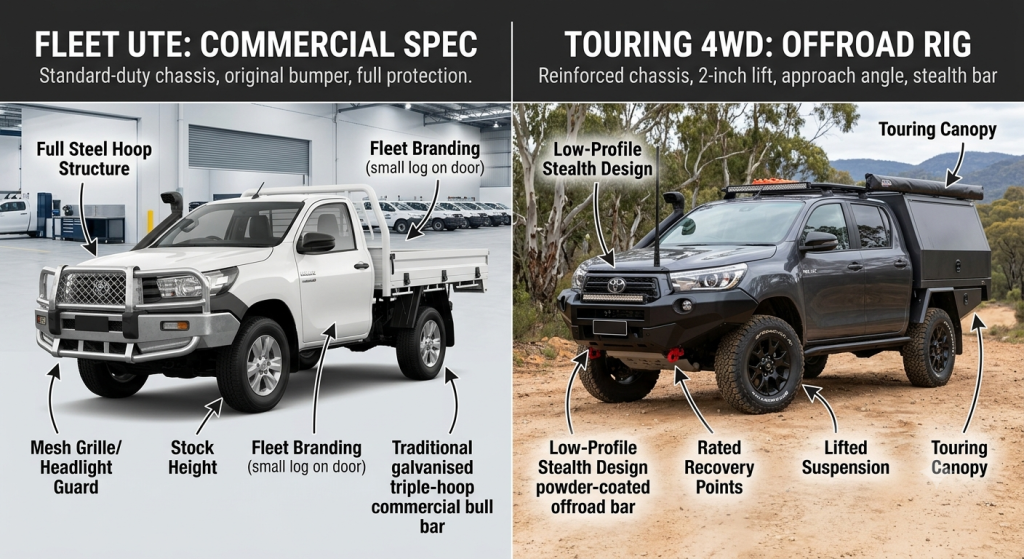
A commercial vs offroad bull bar comparison highlights key differences in headlight hoop protection versus aggressive offroad ground clearance.
1. Quick Overview: Commercial vs Offroad Bull Bar at a Glance
Before diving into technical specifications, reviewing a high-level commercial vs offroad bull bar comparison helps clarify which design matches your vehicle’s daily primary usage:
Feature / Metric
Commercial Bull Bar
Offroad / Touring Bull Bar
Primary Focus
Maximum impact protection, durability, cost efficiency
High approach angles, weight reduction, sleek aesthetics
Physical Profile
Full triple-hoop structure (grille + twin headlight loops)
Single-hoop or hoopless (bumper replacement) profile
Approach Angle
Moderate (prioritizes lower radiator coverage)
Maximum (tapered outer wings for high wheel clearance)
Material Construction
Heavy steel plate or thick commercial alloy
Steel or marine-grade alloy with multi-fold paneling
To accurately weigh a commercial vs offroad bull bar choice, you must understand what defines a commercial-spec front protection system.
                  [ Commercial Bull Bar Architecture ]
                                    │
     ┌──────────────────────────────┼──────────────────────────────┐
     ▼                              ▼                              ▼
[ Full Triple Hoop Structure ]   [ Industrial Steel Frame ]    [ Cost-Effective Finish ]
Protects central grille,         Built to survive high-speed    Satin black or galvanized;
radiator & both headlight wings  kangaroo & livestock strikes   focused on utility over styling
A commercial bar is designed primarily for fleet operators, government departments, station managers, and trade contractors who require uncompromising physical protection at a competitive price point.
Key Characteristics of Commercial Bull Bars
Full Triple-Hoop Protection: A standard commercial design features a central tubular hoop protecting the main grille stack, flanked by twin outer hoops extending over the headlights and front quarter panels. In any commercial vs offroad bull bar impact test, the triple-hoop commercial layout delivers superior physical defense against large animal strikes.
Heavy-Duty Construction: Built using thick steel plate (3mm to 5mm) and heavy structural tubing, commercial bars absorb significant kinetic energy before deforming.
No-Nonsense Functionality: Commercial bars prioritize utility over aggressive styling. They feature basic spotlight brackets, aerial tabs, and steel mesh grille inserts to keep rocks and debris away from the radiator.
Budget Efficiency: Because they feature simplified outer pressings and standardized powder-coat finishes, commercial bars are generally more affordable than specialized offroad bars.
When analyzing a commercial vs offroad bull bar option for recreational 4WD builds, the offroad bar category emphasizes trail performance, high-clearance geometry, and modern vehicle aesthetics.
An offroad bar (often referred to as a touring, competition, or stealth bar) is tailored for enthusiasts who tackle technical tracks, deep ruts, sand dunes, and rock steps.
Key Characteristics of Offroad Bull Bars
Tapered High-Clearance Wings: The outer wings of an offroad bar sweep upward and inward toward the chassis, exposing the front tires. When evaluating a commercial vs offroad bull bar for technical trail driving, the offroad bar provides a far superior approach angle, preventing the bumper from plowing into steep mud banks or rock faces.
Modular Hoop Options: Unlike full triple-hoop commercial units, offroad bars are frequently offered in single-hoop or completely hoopless (stealth) configurations. This provides a modern appearance that blends naturally with factory body lines.
Integrated Recovery Points: Offroad bars feature heavily reinforced, rated recovery points welded directly into the chassis mounting structure, allowing safe snatch or winch extractions from off-camber angles.
Color-Matching & Premium Finishes: Offroad bars are designed to be color-matched to factory paint codes or finished in textured matte powder coating for a refined custom look.
4. Key Performance Comparisons: Commercial vs Offroad Bull Bar
When choosing a commercial vs offroad bull bar, comparing specific performance metrics helps determine which option fits your driving style.
1. Approach Angle & Offroad Clearance
Approach angle refers to the maximum incline angle a vehicle can climb from a horizontal plane without the front bumper making contact.
                      [ Approach Angle Comparison ]
                                    │
     ┌──────────────────────────────┴──────────────────────────────┐
     ▼                                                             ▼
[ Commercial Bull Bar ]                       [ Offroad Bull Bar ]
• Extended lower skirt for radiator shield    • Upswept, tapered outer wings
• Typical Approach Angle: ~26° to 29°         • Typical Approach Angle: ~32° to 36°
• Risk: May drag when exiting steep drop-offs • Advantage: Exposes tire tread to obstacles
If your 4WD trips involve technical rock crawling, steep creek crossings, or high-angle dune climbing, selecting an offroad bar over a commercial bar prevents front-end hang-ups.
2. Weight Distribution & Suspension Load
Weight is a vital factor in any commercial vs offroad bull bar decision.
Commercial Bars: Due to full triple-hoop steel tubing and extended lower skirt paneling, commercial steel bars typically weigh between 65 kg and 85 kg (before adding a winch).
Offroad Bars: Hoopless or single-hoop offroad steel bars often weigh between 45 kg and 65 kg. Alloy offroad options drop weight further to 30 kg – 45 kg.
A lighter offroad bar puts less strain on your front coilover struts, preserves front axle payload, and minimizes vehicle nose-dive under emergency braking.
Both options accommodate electric recovery winches, but their mounting layouts differ in a commercial vs offroad bull bar evaluation:
                  [ Winch Integration Differences ]
                                  │
     ┌────────────────────────────┴────────────────────────────┐
     ▼                                                         ▼
[ Commercial Bar Winch Mounting ]            [ Offroad Bar Winch Mounting ]
• Standard internal winch box                • Recessed high-clearance winch cradle
• Open fairlead mounting on front skirt      • Flush hawse fairlead mount; integrated flip-up plate
• Top/side clutch lever access ports         • Optimized for synthetic rope & quick clutch access
While a commercial bar houses a winch inside an exposed steel box frame, an offroad bar integrates the winch cradle deeper into the chassis rails. This preserves air intake flow to the intercooler while protecting the winch body behind sleek skid plates.
Both commercial and offroad bars pass these tests by utilizing engineered accordion mounting brackets. These steel brackets collapse predictably under severe impact, ensuring the vehicle’s crash sensors fire the airbags on schedule.
Modern 4WDs rely on millimeter-wave radar units, 360-degree cameras, and ultrasonic parking sensors. Premium commercial and offroad bars feature laser-cut relocation ports and acrylic radar windows to preserve full driver-assist functionality.
6. Decision Matrix: Commercial vs Offroad Bull Bar
Use this decision flowchart to determine whether a commercial or offroad bar is best suited for your vehicle:
                  [ What Is Your Vehicle's Primary Purpose? ]
                                       │
           ┌───────────────────────────┴───────────────────────────┐
           ▼                                                       ▼
[ Fleet, Trade, Farm & Rural Touring ]                [ Offroad Ruts, Rock Crawling & Dune Travel ]
           │                                                       │
           ▼                                                       ▼
• Priority: Maximum animal strike protection          • Priority: High approach clearance & tire exposure
• Driving through high-density roo corridors          • Seeking sleek, low-profile body integration
• Budget-conscious, heavy-duty utility                • Weight reduction to preserve front payload
           │                                                       │
           ▼                                                       ▼
 [ CHOOSE COMMERCIAL BULL BAR ]                         [ CHOOSE OFFROAD BULL BAR ]
Choose a Commercial Bull Bar if:
Your vehicle is a work ute, trade vehicle, or fleet truck operating in rural areas.
You prioritize complete coverage (headlights, grille, and bonnet) over aggressive trail clearance.
You frequently travel regional highways at night where kangaroo and livestock strikes are common risks.
You want a heavy-duty, cost-effective frontal protection system.
Choose an Offroad Bull Bar if:
You use your 4WD for technical offroad driving, rock crawling, sand dunes, or steep trail tracks.
You want to maximize your front approach angle and expose your tire tread to trail obstacles.
You prefer a sleek single-hoop or hoopless profile that complements factory body lines.
You want to reduce front axle weight while incorporating rated recovery points.
7. Summary: Selecting the Ideal Bull Bar for Your Build
When comparing a commercial vs offroad bull bar, neither option is inherently superior—the right choice depends entirely on how and where you drive your 4WD.
A commercial bull bar provides complete, cost-effective, triple-hoop shielding designed to survive high-speed animal collisions in the outback.
An offroad bull bar delivers aggressive trail clearance, lighter front-end weight, integrated recovery points, and a refined appearance for technical 4WD touring.
Ensure whichever bar style you choose carries certified ADR compliance, airbag compatibility, and proper housing for your vehicle’s safety radar systems.
Need Expert Advice on Bull Bar Fitment?
Still unsure whether a commercial or offroad bar is best for your 4WD? Contact our technical team at All Model 4×4 Spares. We are here to help you choose a road-legal, high-performance protection setup tailored specifically to your vehicle!