Selecting and installing an engineered dual cab flat tray kit is one of the most effective structural upgrades available for modern four-wheel drive dual cab utility vehicles like the Toyota HiLux and Ford Ranger. Factory sheet metal tub bodies often limit practical gear organization, offer inadequate tie-down points, and suffer severe cosmetic panel damage when navigating tight, overgrown offroad tracks. Upgrading to a modular dual cab flat tray kit replaces the restricted tub space with an expansive, heavy-duty flat deck platform engineered specifically to optimize rear cargo layout, facilitate canopy mounting, and streamline gear access.
For dual cab 4WD owners balancing trade work demands with weekend outback touring, a precision-manufactured dual cab flat tray kit delivers superior deck space while maintaining vehicle balance across the rear axle. Modern CNC laser-cut and pre-bent dual cab flat tray kit options allow home mechanics and professional fabricators to build a high-strength tray assembly tailored to their specific touring setup. From integrating under-tray slide-out drawers and water tanks to mounting heavy-duty headboards and spare wheel carriers, choosing a quality dual cab flat tray kit provides total control over your vehicle’s payload capacity and utility layout.
In this comprehensive technical buyer’s guide, we break down every critical decision factor involved in selecting a dual cab flat tray kit for Toyota HiLux, Ford Ranger, and popular dual cab platforms. From subframe structural mechanics and weight calculations to material selection, ADR transport compliance, and step-by-step assembly protocols, this guide gives you the technical depth required to choose the right dual cab flat tray kit.
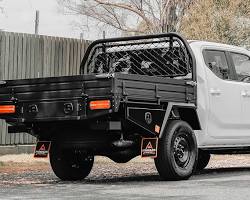
Understanding how a dual cab flat tray kit integrates with a vehicle’s boxed ladder-frame chassis is critical to ensuring long-term structural reliability under heavy offroad loads.
                 [ Dual Cab Flat Tray Kit Engineering Architecture ]
                                          │
  ┌───────────────────────────────────────┴───────────────────────────────────────┐
  ▼                                                                               ▼
[ Heavy-Duty Steel Subframe Architecture ]                      [ High-Strength Modular Alloy Architecture ]
• High-tensile RHS structural steel longitudinal runners         • Lightweight extruded 6061-T6 aluminum floor planking
• Maximum structural yield strength for heavy tool loads         • Saves 60 kg – 100 kg of unladen weight for GVM savings
• Direct chassis bracket mounting with EPDM isolation pads       • Superior natural oxide barrier against coastal salt corrosion
• Ideal for heavy-duty commercial builds and hard working rigs   • Ideal for long-range touring and beach driving setups
The fundamental purpose of a dual cab flat tray kit is to create a rigid load-bearing surface across the rear chassis rails without introducing stress fractures into the vehicle’s frame. Dual cab utility vehicles feature a shorter tray bed length than single cab variants—typically ranging between 1,500mm and 1,800mm—meaning that cargo weight must be carefully positioned over or slightly forward of the rear axle line. A well-designed dual cab flat tray kit utilizes high-tensile longitudinal main runners that sit parallel to the chassis frame, connected by transverse crossmembers that distribute point loads evenly across the deck surface.
Furthermore, proper rubber chassis isolation pads must be installed between the vehicle’s chassis brackets and the subframe runners of your dual cab flat tray kit. These pads damp road harmonic vibrations and allow necessary frame articulation during extreme cross-axle offroad driving, preventing structural stress from transferring directly into the floor deck of your dual cab flat tray kit.
Selecting the right dual cab flat tray kit for your Toyota HiLux, Ford Ranger, or dual cab ute requires assessing specific structural attributes and physical dimensions. Here are seven fundamental criteria to evaluate when choosing a dual cab flat tray kit:
A top-tier dual cab flat tray kit must feature laser-cut, model-specific chassis mounting brackets designed precisely for your vehicle’s factory mounting points. Model-matched brackets on a dual cab flat tray kit ensure a bolt-on fitment without requiring dangerous frame drilling.
The deck length of a dual cab flat tray kit should ideally measure between 1,500mm and 1,800mm. Selecting an overly long deck shifts heavy loads behind the rear axle, compromising vehicle steering geometry and braking stability.
A heavy-duty headboard structure on your dual cab flat tray kit protects the cab’s rear window from shifting cargo during sudden stops. Ensure the headboard on your dual cab flat tray-kit features heavy-wall mandrell-bent tubing or structural sheet fabrication.
Selecting a dual cab flat tray kit engineered to accommodate an under-tray sliding drawer and mudguard toolboxes maximizes storage utility. Integrated toolboxes keep heavy recovery gear low to the ground, improving overall vehicle center of gravity.
Analyzing a dual cab flat tray kit involves choosing between high-yield structural steel and lightweight marine-grade aluminum. Steel kits offer unmatched point-load strength, while aluminum kits maximize available Gross Vehicle Mass (GVM) payload.
Your selected dual cab flat tray kit must accommodate compliant rear LED tail lamp clusters, license plate illuminators, and wheel arch mudguards that comply with national transport regulations.
High-quality dual cab flat tray-kit models feature dual-stage coatings—such as zinc electrostatic e-coating followed by a UV-stable powder coat or spray-on polyurea bedliner—to defend against rock chips and rust.
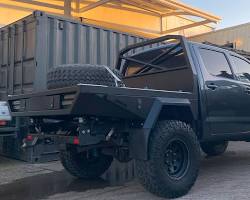
Figure 2: Subframe crossmembers and laser-cut mounting plates in a dual cab flat tray kit ensure rigid load distribution across the chassis.
Comparing technical specifications helps buyers select the right style of dual cab flat tray kit for popular dual cab vehicles:
| Specification / Feature | Heavy Steel Dual Cab Tray Kit | Modular Alloy Dual Cab Tray Kit | Hybrid Steel/Alloy Tray Kit | Factory OEM Sheet Metal Tub |
| Compatible Models | HiLux, Ranger, D-Max, Triton, Navara | HiLux, Ranger, D-Max, Triton, Navara | HiLux, Ranger, D-Max, Triton, Navara | Vehicle Specific OEM Tub |
| Average Unladen Weight | 150 kg – 210 kg | 85 kg – 125 kg | 115 kg – 155 kg | 110 kg – 140 kg |
| Main Runner Material | 75x40mm Structural Steel RHS | 80x50mm Extruded Aluminum | 75x40mm Structural Steel RHS | Thin Stamped Sheet Metal |
| Standard Deck Length | 1,500mm – 1,800mm | 1,500mm – 1,800mm | 1,500mm – 1,800mm | 1,520mm – 1,560mm |
| Static Load Rating | 1,500+ kg Static Load | 1,000+ kg Static Load | 1,250+ kg Static Load | 600–800 kg Distributed |
| Under-Tray Drawer Option | Fully Integrated Support | Fully Integrated Support | Fully Integrated Support | Extremely Restricted |
| Offroad Protection Level | Extreme Heavy-Duty Armor | High-Grade Touring Shield | High-Grade Touring Shield | Low Impact Resistance |
Evaluating material characteristics ensures you choose a dual cab flat tray-kit that balances structural strength against total vehicle Gross Vehicle Mass (GVM) constraints.
                    [ Material Selection for Dual Cab Flat Tray Kits ]
                                            │
  ┌─────────────────────────────────────────┴─────────────────────────────────────────┐
  ▼                                                                                   ▼
[ Structural Carbon Steel (Grade 250/350 RHS) ]                     [ Marine-Grade 6061-T6 Aluminum ]
• High Modulus of Elasticity (200 GPa) resists heavy point loads    • Low density cuts unladen mass by 35% to 50%
• Superior plastic deformation prevents catastrophic cracking       • Superior natural oxidation resistance against salt
• Simple field repairability using standard MIG or stick welding    • Helps keep vehicle weight within legal GVM thresholds
• Requires multi-layer zinc primer and powder coat protection       • Requires isolation hardware against galvanic reaction
A steel dual cab flat tray kit provides maximum yield strength and impact resilience. Structural RHS (Rectangular Hollow Section) runners handle concentrated heavy loads, making a steel dual cab flat tray-kit ideal for tradespeople transporting heavy tools, machinery, or dense cargo. While a steel dual cab flat tray-kit adds more unladen mass to the vehicle than an aluminum equivalent, its structural durability across corrugated offroad tracks is outstanding.
For dual cab owners focused on keeping total vehicle weight within legal Gross Vehicle Mass (GVM) limits, an aluminum dual cab flat tray kit offers a major payload advantage. Utilizing high-strength 6061-T6 extruded aluminum floor decking reduces total tray mass by 50 kg to 90 kg compared to steel. An aluminum dual cab flat tray kit is naturally corrosion-resistant, making it a popular choice for coastal driving and long-distance touring builds equipped with heavy slide-on canopies.
Installing your dual cab flat tray-kit systematically ensures components align correctly with your vehicle’s factory chassis mounts and wiring harnesses.
1.Unpack Kit and Inspect Vehicle Chassis Mounts:Prepare workshop space, unpack components, and check hardware inventory.
Clear a level assembly area. Unpack your dual cab flat tray kit and cross-reference all laser-cut brackets, runners, crossmembers, side boards, and high-tensile fasteners against the packing list.
2.Assemble and Square the Subframe Structure:Connect longitudinal runners with crossmembers and confirm squareness.
Lay out the main structural runners and bolt or tack-weld the crossmembers for your dual cab flat tray-kit. Measure diagonally corner-to-corner to confirm the subframe is perfectly square before torquing hardware.
3.Position Chassis Isolation Strips and Mount Brackets:Damps road vibration and prevents chassis metal-on-metal chafing.
Place heavy-duty EPDM rubber isolation pads along your vehicle’s chassis mounting points. Secure the chassis mounting brackets for your dual cab flat tray-kit loosely to allow final alignment adjustments.
4.Install Deck Planking and Secure Side Drops:Secure floor planks starting from the front headboard working rearward.
Position floor deck planks onto the subframe starting against the front headboard. Fasten the floor sheets on your dual cab flat tray kit using countersunk stainless steel bolts or heavy blind rivets.
5.Mount Mudguards, Wire Lights, and Torque Fasteners:Attach mudguards, connect LED lights, and verify all clearances.
Install wheel arch mudguards ensuring full suspension travel clearance. Wire rear LED lights into the vehicle’s factory harness using weather-sealed connectors, then torque all chassis fasteners to spec.
explore our complete range of 4x4 armor, side steps, and rock sliders
When assembling and fitting a dual cab flat tray-kit, verifying compliance with national transport regulations is essential. In Australia, vehicle modifications are governed by standards published by the Federal Register of Legislation under Australian Design Rules ADR 13/00 (Installation of Lighting) and ADR 42/00 (General Safety Requirements).
                  [ ADR Transport Safety Compliance Rules ]
                                     │
   ┌─────────────────────────────────┼─────────────────────────────────┐
   ▼                                 ▼                                 ▼
[ Maximum Rear Overhang Limits ]  [ Mudguard Coverage Rules ]       [ Rear Lamp Visibility Angles ]
• Must not exceed 60% of wheel    • Mudguards must cover full tire  • Tail lights must remain visible
  base or maximum 3.7 meters       tread width and 45-deg rear angle  at mandatory 45-degree angles
Protecting your completed dual cab flat tray kit against stone spray, mud accumulation, and heavy cargo abrasion extends its operational service life.
Examining real-world build configurations demonstrates how different vehicle owners assemble a dual cab flat tray kit to suit their specific requirements:
Use this helpful summary checklist when purchasing and assembling a dual cab flat tray kit: