
Installing a robust frontal protection system is one of the most practical upgrades you can make to an Australian Toyota Hilux. Whether you are driving highway stretches through animal-prone areas at dusk, negotiating tight bush tracks, or outfitting a work ute for daily site duties, a purpose-built bull bar guards your engine bay, radiator, and cooling system against catastrophic damage.
However, buying a Hilux bull bar is not a one-size-fits-all process. Toyota’s Seventh Generation (N70: 2005–2015) and Eighth Generation (N80: 2015+ present) Hilux platforms have entirely distinct chassis mounting structures, front-end body contours, weight tolerances, and electronic safety systems. Fitting the wrong bar or ignoring generation-specific design changes can lead to panel misalignment, sensor errors, or invalid road licensing.
This buying guide breaks down everything you need to know about selecting, fitting, and legally running a bull bar on both N70 and N80 Toyota Hilux models in Australia.
Understanding the Generations: N70 vs. N80 Hilux Platforms
Before looking at styles or finishes, you must correctly identify your Hilux generation and sub-series. Bull bar mounting brackets, body cuts, and winch cradles are manufactured to millimetre-accurate tolerances for specific chassis rails.
+------------------------+-------------------+--------------------------------------------+
| Hilux Generation       | Production Years  | Key Front-End Identifying Features         |
+------------------------+-------------------+--------------------------------------------+
| N70 (Series 1 / Pre)   | 2005 – 2011       | Rounded headlights, classic bonnet scoop   |
| N70 (Series 2 / Face)  | 2011 – 2015       | Angular headlights, horizontal slate grille|
| N80 (Early)            | 2015 – 2018       | Integrated sleek grille, wide headlight   |
| N80 (Facelift / Tech)  | 2018 – Present    | Trapezoidal grille, Toyota Safety Sense   |
+------------------------+-------------------+--------------------------------------------+
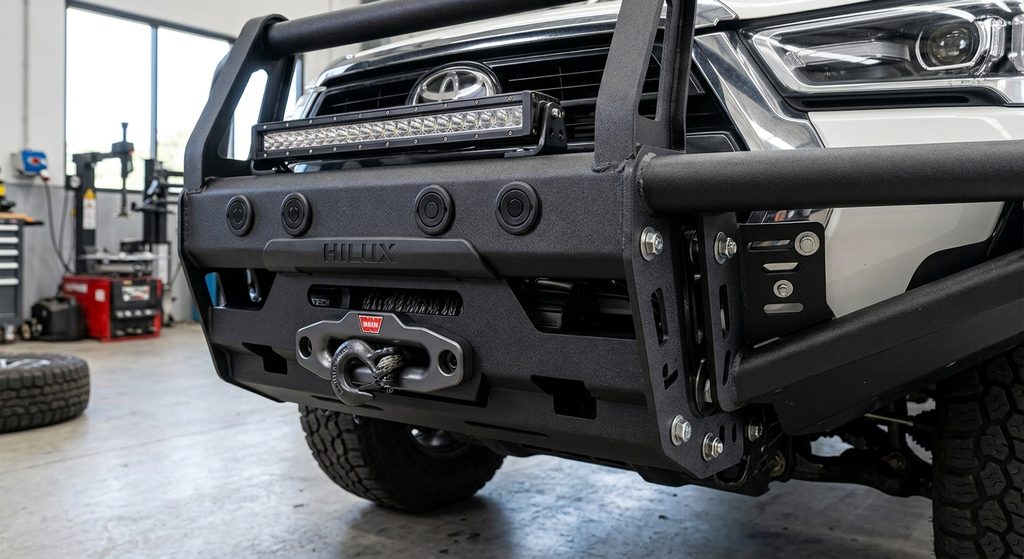
The N70 Platform (2005–2015)
The N70 platform is renowned for its mechanical simplicity and off-road durability. However, it went through a major facelift in late 2011:
- 2005–2011 (Pre-Facelift): Features rounder body lines and a distinctive front profile. Bars designed for these early models, such as the dedicated Toyota Hilux Muzz bar N70 2005-11 Solid (Pre Facelift) Bull Bar, account for the factory bumper profile and body-lift parameters without interfering with airflow to the intercooler.
- 2011–2015 (Facelift): Received a wider, flatter grille, redesigned front guards, and altered mounting mounting distances. An N70 pre-facelift bar will not align correctly with a post-2011 N70 front end.
The N80 Platform (2015–Present)
The N80 brought a broader chassis, stiffer front frame sections, and higher payload specs, alongside complex electronic safety features.
- 2015–2018: Bumper trim cuts or full-replacement bumper designs must align precisely with the wider flare profiles and lower radiator support mounts.
- 2018+ (Facelift & Tech Upgrade): Introduced factory autonomous emergency braking (AEB), lane departure alerts, radar sensors behind the front emblem, and parking sensors integrated into the front bumper shell. Installing an N80 hoop bull bar on these models requires built-in sensor housing ports and laser-cut radar relocation windows to keep safety systems active.
Choosing the Right Bull Bar Style for Your Rig
The best bar depends on how you use your vehicle, how much weight your suspension can handle, and the level of impact protection you need.
       [ Triple Hoop / 5-Post ]          [ Single Hoop / Bumper Cut ]       [ Stealth / Muzz Bar ]
       ------------------------          ----------------------------       ----------------------
       * Maximum animal protection       * Balanced weight & clearance      * Sleek, high-clearance
       * Rural touring & country roads   * Daily work & off-road tracks     * Modern aesthetics & winch
1. Triple Hoop & 5-Post Bars
Triple hoop bars feature a central top tube with outer loops covering both headlight assemblies.
- Best for: Outback touring, long-distance remote travel, and high-risk animal strike areas.
- Pros: Maximum frontal cover; protects the radiator, headlights, and front guards from side-angled impacts.
- Cons: Higher overall front-axle weight.
For ultra-heavy-duty environments—such as rural cattle properties or remote country roads—a dedicated heavy-duty Ultimate Deluxe Bull Bar provides structural steel protection with an integrated winch cradle.
2. Single Hoop & Bumper-Replacement Bars
Single hoop designs use a single center tube surrounding the radiator grille, leaving the outer wings open above the main bumper steel.
- Best for: General off-roading, rock crawling, and daily work vehicles.
- Pros: Excellent approach angles, reduced overall weight compared to triple-hoop bars, cleaner modern aesthetic.
- Cons: Less upper corner protection against jumping wildlife or overhanging branch strikes.
3. Stealth, Slimline, and Muzz-Style Bars
Muzz-style and slimline steel bars provide high approach angles and structural strength while maintaining a modern, aggressive look.
- Best for: Custom touring builds, weekend tracks, and drivers who want utility without a bulky traditional frame.
- Pros: Compact front-end footprint, built-in light bar mounts, zero body-lift winch mounting options.
Material Selection: Steel vs. Aluminium vs. Polyurethane
+-------------------+-----------------+------------------+-----------------+
| Material          | Structural Strength | Front Axle Weight | Maintenance Level |
+-------------------+-----------------+------------------+-----------------+
| Structural Steel  | Highest         | Heavy (45–75kg)  | Low (Powdercoat) |
| Alloy / Aluminium | Medium          | Light (25–40kg)  | High (Polishing)|
| Polyurethane      | Elastic Recovery| Medium (30–45kg)  | Low (UV-stable) |
+-------------------+-----------------+------------------+-----------------+
Structural Steel
Steel remains the benchmark for Australian bush protection due to its tensile strength and impact resistance.
- Advantages: Steel deforms predictably under severe impacts, absorbing energy rather than cracking. It can easily be repaired or welded in remote towns if damaged.
- Considerations: Added weight. A full steel bar, winch, and spotlight setup can add 70kg–100kg directly over the front axle, often requiring upgraded front coil springs.
Aluminium Alloy
Aluminium bars offer a lightweight alternative for vehicles operated close to their Gross Vehicle Mass (GVM) limit.
- Advantages: Weighs roughly 30%–40% less than steel; naturally resistant to rust if scratched.
- Considerations: Alloy is more brittle under repeated heavy impacts and harder to repair in remote areas.
Legal, ADR, and Safety Considerations in Australia
Installing a bull bar in Australia is regulated by state transport authorities and federal vehicle standards. Non-compliant front-end accessories can unroadworthy your vehicle, invalidate your insurance coverage, or compromise airbag deployment in an accident.
1. ADR 69/00 Compliance (Full Frontal Impact Protection)
For SRS airbag-equipped Hilux models (all N80 and most N70 variants), the bull bar mounts must incorporate engineered crumple zones or accordion-style brackets. These mounts absorb low-speed impacts without triggering airbag sensors while allowing the exact deceleration force needed to trigger airbags in a high-speed collision. Ensure your chosen bar is explicitly certified to maintain ADR 69 compliance.
According to the official Australian Design Rules (ADR) guidance, any frontal protection system fitted to an airbag-equipped vehicle must not compromise the original crash-pulse characteristics certified during vehicle manufacturing.
2. Australian Standard AS 4876.1
AS 4876.1 governs the physical profile of vehicle frontal protection systems. Key visual and design standards include:
- The bar profile must conform to the overall contour of the Hilux front end.
- No sharp forward-facing projections, exposed bracket edges, or fishing rod holders are permitted while driving on public roads.
- Headlights, indicators, and park lights must not be obscured.
3. Forward Visibility and Driver Assist Systems
On 2018+ N80 Hiluxes fitted with Toyota Safety Sense (TSS), the millimeter-wave radar housed behind the front Toyota badge requires an unobstructed field of view. If fitting a bar with a high central hoop, ensure it does not block the radar’s field of view or the windshield camera array.
Refer to the official National Code of Practice for Light Vehicle Construction and Modification (VSB 14) to review specific height, projection, and mounting guidelines enforced across Australian states.
Weight, Suspension, and GVM Management
Adding frontal accessories changes your vehicle’s weight distribution. Factory Toyota Hilux suspension springs are valved for a unladen front axle.
Standard Factory Setup ----> Add Steel Bar + Winch + Lights ----> Result: Front Suspension Sag
                                                                       |
                                                                       v
                                                           Requires Upgrade to 50mm
                                                           Constant Heavy-Duty Coils
- Front-End Sag: A heavy steel bar will cause factory coil springs to compress, reducing overall ground clearance, wheel travel, and approach angles.
- Suspension Upgrade: If you plan to mount a heavy steel bar alongside a dual-motor winch and driving lights, upgrade your front struts with heavy-duty constant-load coils rated for an extra 50kg–100kg.
- GVM Limits: Keep track of your Gross Vehicle Mass limits. For detailed guidance on safe installation, read our guide on how to install bull bars safely before starting your installation.
Summary Checklist: Before You Buy
Before ordering your Toyota Hilux bull bar, run through this final pre-flight checklist:
- Verify Your Model Code & Year: Confirm whether your vehicle is an N70 (2005–2011 or 2011–2015 facelift) or an N80 (2015–2018 or 2018+ tech facelift).
- Determine Primary Usage: Match the bar style (triple hoop, single hoop, or stealth Muzz style) to your driving conditions.
- Check Safety Compatibility: Confirm the bar includes factory parking sensor cutouts, fog light adapters, and radar-relocation windows if your N80 features active safety systems.
- Factor In Weight: Account for front coil spring requirements if choosing a full-featured steel bar and winch combination.
- Verify ADR Compliance: Ensure the mounting bracket system is independently certified for SRS airbag safety.
If you are upgrading your Hilux for touring, work, or off-road exploration, browse the complete All Model 4×4 Spares range or contact our team to confirm fitment, bracket options, and accessory compatibility for your specific build.
FAQ SECTION
Do N70 and N80 Hilux bull bars use the same mounting brackets?
No, N70 and N80 chassis rails, bumper contours, and mounting points are completely different. An N70 bull bar cannot be safely or legally bolted onto an N80 chassis without compromising structural integrity and ADR airbag compliance.
Will fitting a bull bar trigger airbag warnings on my Hilux?
Not if you select an ADR 69-compliant, airbag-compatible bull bar specifically designed for your vehicle generation. Compliant bars feature engineered mounts designed to work alongside factory SRS sensor trigger thresholds.
Can I fit a bull bar to an N80 Hilux with Toyota Safety Sense (TSS)?
Yes, but you must choose a bar engineered with integrated radar relocation brackets and sensor housings. Obstruction of the front grille radar or windshield camera array can cause false autonomous braking alerts or system failure.
Do I need to upgrade my front suspension after installing a steel bull bar?
In most cases, yes. A steel bar and winch add 60kg–90kg over the front axle, causing factory coil springs to sag. Upgrading to heavy-duty constant-load front coils restores factory ride height and improves handling.
What is the difference between a pre-facelift and facelift N70 Hilux bull bar?
Toyota altered the front grille, headlights, and bumper trim on the N70 platform in late 2011. Pre-facelift (2005–2011) bars account for a rounder headlight contour, whereas post-2011 facelift bars fit a wider, flatter front grille assembly.