
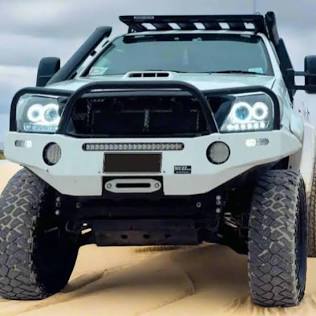
When outfitting a seventh-generation Toyota Hilux for rugged Australian touring, off-roading, or worksite duties, upgrading front-end protection is a top priority. While full-size steel triple-hoop bull bars offer massive animal strike protection, their 75kg+ overhang weight causes noticeable front-end nose-dive on independent front suspension (IFS). Conversely, thin-walled alloy nudge bars bend under the slightest track impact. This trade-off led to the popularity of the muzz bar n70 across the Australian dual-cab community.
A modern muzz bar n70 provides an aggressive, high-clearance steel bumper replacement that bolts directly across the vehicle’s structural ladder frame. It incorporates a heavy-duty low-mount winch cradle and recovery points while cutting front-axle overhang weight by nearly half. However, fitting a muzz bar n70 requires close attention to the structural facelift changes Toyota introduced halfway through the seventh-generation production run.
This technical guide breaks down everything you need to know about a muzz bar n70—covering pre-facelift versus facelift differences, bumper-cut procedures, winch packaging, approach angle gains, and Australian road regulations.
Pre-Facelift vs Facelift Architecture: 2005–2011 vs 2011–2015
The seventh-generation Hilux spans a decade of production in Australia. When choosing a muzz bar n70, understanding the exterior changes between early and late models is critical:
[ Pre-Facelift N70: 2005 to Mid-2011 ]
• Teardrop, rounded headlight clusters
• Curved three-bar grille integrated into the upper bumper
• Higher bumper cut-line beneath the headlights

[ Facelift N70: Late 2011 to 2015 ]
• Sharper, squared headlight assemblies
• Wider, deeper three-dimensional chrome grille
• Lower grille baseline drops ~25mm lower into the bumper apron
- Pre-Facelift Models (2005–mid 2011): These early models feature rounded headlights and a shallower front grille. A dedicated N70 muzz bar engineered for pre-facelift cabs follows the gentle curve of the early bumper line, tucking up close to the radiator core support.
- Facelift Models (late 2011–2015): In late 2011, Toyota restyled the front end with squared headlights and a deeper grille. If you attempt to bolt a pre-facelift muzz bar n70 onto a 2012–2015 model, the deeper grille will contact the top deck of the bar, preventing the bonnet from latching properly.
- Chassis Horn Foundation: Both early and late N70 models share the same underlying ladder chassis rails. The bolt centers across the front chassis horns are identical, meaning subframe mounting brackets align across all model years, even though the outer sheet-metal cuts differ.
Why Choose a Muzz Bar Over a Traditional Nudge Bar?
Many ute owners wonder how a muzz bar n70 differs from a standard tubular nudge bar. In reality, their construction and recovery strength belong in completely different classes:
| Feature Category | Factory / Dealer Alloy Nudge Bar | Structural Steel Muzz Bar N70 | Full 3-Hoop Steel Bull Bar |
| Base Material | Thin-walled hollow extruded aluminium | 4mm–5mm laser-cut high-tensile steel | 3mm–5mm folded steel with 63mm pipe loops |
| Mounting Points | Lower radiator support / tie-down loops | Rigid front ladder chassis horn plates | Heavy-duty chassis subframe brackets |
| Winch Capability | None (Folds under recovery load) | Yes (Integrated 5mm steel winch cradle) | Yes (Houses 9,500lb–12,000lb winches) |
| Recovery Points | None (Relies on factory transport loops) | Integrated high-tensile recovery points | Heavy-duty chassis-mounted recovery lugs |
| Approach Angle | Often decreases front clearance | Dramatically increases approach angle | Increases clearance with higher front weight |
| Front Overhang Mass | 12kg to 18kg | 28kg to 42kg | 65kg to 85kg+ |
[ Impact Failure on Traditional Nudge Bar ]
Track Impact ======> [ Thin Alloy Tubing ] ======> Pushes Back ======> Radiator Core Crushed

[ Impact Dispersion on a Muzz Bar N70 ]
Track Impact ======> [ 5mm Steel Center Pan ] ======> Absorbed Directly by Chassis Horns
A standard nudge bar hangs low below the front valance, reducing clearance and acting as a plough in sand or mud. A muzz bar n70 trims away the fragile plastic bumper wings, tucking high against the bodywork to give the front tyres an unobstructed path to climb steep ledges.
Winch Compatibility, Footprint, and Recovery Load Paths
For solo touring and remote bush exploration, pairing your muzz bar n70 with a dependable electric recovery winch is essential.
       [ Toyota Hilux N70 Ladder Chassis Rails ]
               |                       |
               v                       v
     [===========================================]  <-- Independent 5mm Steel Winch Cradle
     [        12,000lb Low-Mount Winch           ]      (Feeds pull loads straight to frame)
     [===========================================]
                           |
     [          Muzz Bar N70 Outer Shell         ]  <-- Floats over chassis recovery cradle
- Independent Chassis-Mounted Cradle: An authentic muzz bar n70 incorporates a separate 5mm steel winch bed that bolts directly across the vehicle chassis horns. As detailed in our guide on the best bull bars for winches, heavy angled recovery forces must feed straight into the chassis rails rather than bearing on the cosmetic outer skin.
- Standard Winch Footprint: A high-quality muzz bar n70 uses the universal 254mm x 114.3mm (10″ x 4.5″) low-mount bolt pattern, accommodating standard 9,500lb to 12,000lb low-mount winches.
- Clutch Gearbox Clocking: When installing a winch into a muzz bar n70, rotate (clock) the clutch gearbox housing forward. This ensures you can easily engage the free-spool clutch lever through the top access ports without grazing your knuckles against the lower grille.
- Synthetic Rope Preference: Running synthetic rope rather than steel wire cable saves roughly 10kg to 12kg over the front overhang, keeping front-end tare weight to a minimum.
Independent Front Suspension (IFS) Dynamics & Weight Savings
The N70 Hilux features a double-wishbone independent front suspension (IFS) with coil-over shock absorbers. IFS setups are sensitive to front overhang mass:
        Front Overhang Load (~55-75kg)
        [ Muzz Bar N70 + Winch + Bash Plate ]
                      \
                       v
                [O===========O] ---------------------- [O===========O]
              Front IFS Wheels                        Rear Leaf Axle
             (Front GAWR: 1,300kg)
Adding an 85kg traditional steel bull bar, a 40kg steel-cable winch, and driving lights places up to 135kg over the front bumper. On factory N70 front springs, this causes:
- Front suspension sag of 25mm to 35mm, drastically reducing upward travel.
- Frequent bottoming-out against the rubber bump stops over rough washboard corrugations.
- Accelerated wear on upper and lower ball joints and inner tyre edges.
A muzz bar n70 provides the perfect balance. Weighing between 28kg and 42kg, it causes minimal front suspension sag (roughly 5mm to 10mm) on factory springs. You gain genuine winch recovery and impact defense without needing an immediate front suspension lift.
For touring drivers who also want to block outback cabin heat soak, pair your setup with vehicle-specific cab accessories like the Solid N70 Hilux Sunvisor or N70 Hilux Sunvisor Touring Shield to keep your dashboard protected on long highway runs.
Step-by-Step Installation: Pre-Facelift & Facelift Bumper Cuts
Fitting a muzz bar n70 in a home workshop requires careful measuring and precise bumper cutting:
[Remove Factory Grille & Bumper Clips]
                  │
                  ▼
[Apply Masking Tape & Measure Bumper Cut Lines]
                  │
                  ▼
[Execute Bumper Cut with Oscillating Multi-Tool]
                  │
                  ▼
[Fit Black Rubber Pinch-Weld Edge Trim to Plastic]
                  │
                  ▼
[Bolt 5mm Steel Winch Cradle Across Chassis Horns]
                  │
                  ▼
[Mount Winch, Fairlead & Route Heavy-Duty Wiring]
                  │
                  ▼
[Hang Muzz Bar N70 Shell & Set 18mm Guard Clearance Gap]
                  │
                  ▼
[Torque High-Tensile Bolts to Spec & Pin Shear Bolts]
1. Preparing the Bumper Cut
Apply two layers of automotive masking tape across the front bumper apron below the headlights. On pre-facelift models (2005–2011), the cut line follows approximately 20mm beneath the lower headlight edge. On facelift models (2011–2015), the cut drops lower to follow the wider grille contour.
2. Cutting the Plastic Apron
Measure the supplied cut template twice. Use an oscillating multi-tool or fine-tooth body saw to cut roughly 3mm outside your reference line. Sand the raw plastic edge smooth with a sanding block before pressing the black rubber pinch-weld edge trim over the cut line for a factory-clean finish.
3. Chassis Horn Bolt-Up
Unbolt the factory front tie-down brackets from the chassis horns. Clean away road grime from the chassis face plates using wax and grease remover. Bolt the internal 5mm steel winch subframe directly across the chassis horns using the supplied high-tensile fasteners.
4. Setting the Body-to-Chassis Gap
Because the Hilux cab sits on rubber body mounts while the muzz bar n70 bolts to the rigid steel chassis, the cab flexes independently over rough tracks. Maintain an even 15mm to 20mm clearance gap between the outer wings of the muzz bar n70 and the bottom of your front mudguards. If fitted flush, normal off-road chassis twist will force the steel bar into the front panels, denting your guards.
Australian Road Regulations and Compliance Standards
Any aftermarket front bar fitted to a road-registered Australian vehicle must comply with strict state and national safety standards:
- ADR 69/00 & ADR 73/00 (Occupant Crash Protection): A road-legal muzz bar n70 incorporates engineered subframe brackets with calculated crumple zones. In a high-speed collision, the brackets compress at a calibrated rate, transmitting deceleration pulses to the chassis sensors so SRS airbags deploy without delay.
- Australian Standard AS 4876.1-2002: Regulates motor vehicle frontal protection systems. The bar profile must conform closely to the shape of the vehicle’s front end, all forward-facing surfaces and brackets must feature rounded edges with a minimum 5mm radius, and open tube ends must be capped or returned to the vehicle body to protect pedestrians.
- State Field of View and Lighting Guidelines: As detailed in Transport Victoria VSI 1 Bull Bar Standards and Transport for NSW Vehicle Frontal Protection System Guidelines, a front bar cannot project upward into the driver’s 11-metre forward road viewing plane or obscure front indicators, headlights, or licence plates. Furthermore, the overall installation must adhere to national frameworks under the Department of Infrastructure ADR Vehicle Standards to maintain ongoing roadworthiness.
Frequently Asked Questions
Will a pre-facelift muzz bar n70 fit a 2013 facelift Hilux?
Not without modifications. While the underlying chassis rail dimensions are identical across all 2005–2015 N70 models, the front bodywork changed in late 2011. Facelift models feature a deeper, wider grille that extends roughly 25mm lower than the pre-facelift version. A pre-facelift muzz bar n70 will contact the bottom of the facelift grille, preventing the bonnet from latching properly. Always choose a bar specified for your build year.
Can I mount a 12,000lb winch inside a muzz bar n70?
Yes. An authentic muzz bar n70 features an independent 5mm high-tensile steel winch cradle that mounts directly across the chassis horns. It utilizes the universal 254mm x 114.3mm low-mount footprint, easily accommodating standard 9,500lb to 12,000lb electric winches with synthetic rope.
Does a muzz bar n70 cause front suspension sag?
Minimal. A bare muzz bar n70 weighs roughly 28kg to 42kg, compared to 65kg to 85kg for a full-size steel triple-hoop bar. On standard factory front springs, this added mass results in only 5mm to 10mm of sag. If paired with a synthetic-rope winch, the vehicle retains factory ride height and steering geometry without requiring an immediate suspension upgrade.
Is a muzz bar n70 street legal in Australia?
Yes. A muzz bar n70 is 100% road legal across all Australian states and territories, provided it complies with Australian Standard AS 4876.1 and Australian Design Rules (ADR 69/73). The bar must follow the front contour of the vehicle, feature smooth, rolled edges with a minimum 5mm radius, avoid obscuring primary lighting, and sit safely below the driver’s 11-metre forward road vision line.
How does a muzz bar n70 improve off-road approach angles?
A muzz bar n70 replaces the bulky, low-hanging factory plastic bumper with high-tucked steel wings that sit higher than the front crossmember. This increases the front approach angle from roughly 29 degrees to over 37 degrees, allowing the front tyres to bite into steep ledges and sand dunes before the bodywork contacts the obstacle.
Summary: Building a Tough, High-Clearance N70
Investing in a muzz bar n70 provides the ideal balance of recovery strength, high approach angles, and reduced front-axle weight for your seventh-generation Toyota Hilux. By understanding the structural differences between pre-facelift and facelift models, measuring bumper cuts carefully, and securing an independent winch cradle directly across the chassis horns, your Hilux will be ready for the toughest tracks with complete confidence.
Explore the dedicated N70 muzz bar to upgrade your front-end protection, check out our full range of 4WD bull bars and front accessories for alternative touring styles, or pair your build with heavy-duty exterior 4WD sun visors to block outback cabin heat soak.