
Piloting a 70 Series Toyota LandCruiser across regional transport routes, pastoral cattle stations, or remote outback tracks is about as iconic as Australian four-wheel driving gets. Whether you drive a single-cab farm ute, a work-ready dual-cab, an overland Troop Carrier, or a 76 Series wagon, the Cruiser is built for punishment. But heading out into unfenced scrub or desert transport corridors without frontal protection is asking for trouble. Hitting a stray bullock, camel, or a large kangaroo at 100 km/h will crush your factory bumper, push the radiator into your engine fan, and leave you stranded thousands of kilometres from assistance. That is why fitting an authentic steel arb 70 series bullbar paired with heavy-duty side scrub rails is considered essential armor across regional Australia.
However, getting an arb 70 series bullbar mounted up properly requires looking far deeper than simply bolting on a steel bumper. Over the years, Toyota made significant changes to the 70 Series front end, widening the chassis rails in 2007 to squeeze in the 4.5L V8 turbo-diesel and updating front flares and safety tech on later models. If you buy the wrong bar width, miss the chassis crush-can brackets, or clamp side brush rails too close to your front quarter panels, you risk damaging your vehicle’s bodywork on rough corrugations. Understanding chassis horn mounting, flare cutouts, brush rail clamp mechanics, and front coil spring upgrades is critical before you start turning spanners in the shed.
This plain English buyer’s guide breaks down everything you need to know about an arb 70 series bullbar package—from wide-front V8 compatibility and scrub rail integration to winch cradles, suspension loads, and Aussie road rules.
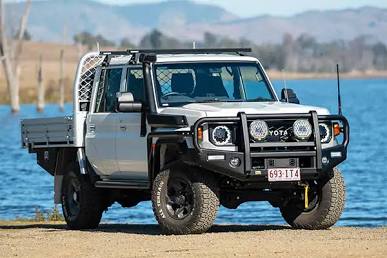
Narrow-Front vs Wide-Front: Understanding 70 Series Cab Widths
Before you buy an arb 70 series bullbar, you must know which cab generation you are fitting:
[ Toyota LandCruiser 70 Series Front-End Evolution ]

1. Narrow-Front Era (Pre-2007: HZJ75, HZJ78, HZJ79)
   ├── Fitted with 1HZ 4.2L naturally aspirated diesel or 1FZ-FE petrol
   ├── Narrow front chassis rail spacing and slim front sheet metal
   └── Uses a narrow-track frontal bar profile

2. Wide-Front Era (2007 to 2023: VDJ76, VDJ78, VDJ79)
   ├─ Front chassis widened by 50mm to clear the 1VD-FTV 4.5L V8 engine
   ├── Bulbous front guards with factory plastic flares (Workmate is flareless)
   └── REQUIRES A DEDICATED WIDE-FRONT ARB 70 SERIES BULLBAR!

3. Updated Facelift Era (Late 2023 Onward: 1GD 2.8L & V8 Facelift)
   ├── Updated squared-off bonnet, heritage grille, and modern safety radar
   └── Requires radar-compatible center apertures and updated wing profiles
- The 2007 V8 Chassis Widening: When Toyota shoehorned the 4.5L V8 engine into the 70 Series in 2007, they widened the front ladder chassis rails by roughly 50mm. An arb 70 series bullbar built for a wide-front V8 ute features wider chassis mounting brackets and broader channel wings to match the flared front mudguards. A narrow-front bar from an older 1HZ Cruiser will not bolt onto a V8 chassis without heavy fabrication.
- Flared (GXL) vs Non-Flared (Workmate): If you drive a base Workmate model without factory plastic over-fender flares, standard GXL-width bars will protrude roughly 40mm wider than your steel guards on each side. A dedicated non-flared arb 70 series bullbar pulls the outer wing tips in tighter to keep your front profile completely flush and road legal.
If you are looking for a complete commercial protection package that combines full-width steel frontal defense with matching wheel-arch scrub rails, the ARB 70 SERIES BULLBAR & SIDERAILS Solid delivers heavy-gauge steel, integrated winch mounting, and matching brush rails designed specifically for 2007+ models.
To check out alternative commercial designs across our full catalog, browse our live Bull Bars category to find the ideal match for your touring rig.
Why Pair Your Bullbar with Side Rails & Steps?
While an arb 70 series bullbar protects your radiator, headlights, and steering gear during a head-on animal collision, outback tracks throw hazards at your flanks as well:
[ Why Add Side Scrub Rails and Steps? ]
• Scrub & Limb Deflection: Pushes heavy tree branches away from your front mudguards
• Animal Glance Protection: Stops kangaroos from bouncing off the bar into your doors
• Rock Slider Defense: Heavy steel steps protect door sills from high-centering on rocks
• Vehicle Jacking Points: Provides high-strength lift points for off-road recovery jacks
| Protection Feature | Bare Bullbar Only | Bullbar + Side Rails & Steps Package |
| Direct Head-On Animal Strikes | Full radiator & engine defense | Full radiator & engine defense |
| Glancing Corner Strikes | Mudguards remain vulnerable to impact | Pushes animals clear of front quarter panels |
| Tight Scrub & Overhanging Branches | Branches slide off wings into panels | Continuous tubular steel shields front guards |
| Chassis Rock Slider Defense | Factory tin steps crush on rock ledges | Heavy-duty steel steps protect lower sills |
| Cab Step Accessibility | No change to factory step height | Heavy steel checker plate provides solid grip |
[ Side Rail Load Dispersion Workflow ]

Glancing Tree Branch or Kangaroo Strike
                  │
                  ▼
[ Outer Tubular Scrub Rail (60.3mm Steel) ]
                  │
         ┌────────┴────────┐
         ▼                 ▼
[ Bullbar Outer Wing ]   [ Chassis Rock Slider Step ] ───> Ladder Chassis Rail
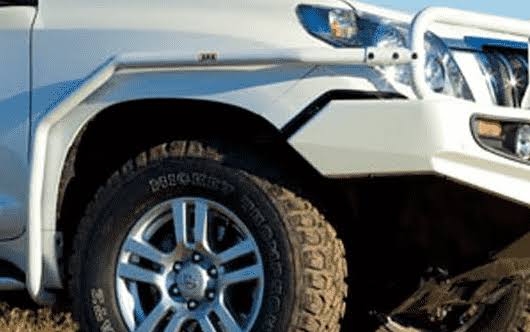
- Glancing Strike Protection: When you strike an animal at highway speeds, it rarely stays dead-center. In many collisions, the animal deflects off the bull bar wing and slams down the side of your ute, caving in the front guard and front door. Linking your arb 70 series bullbar directly to tubular steel side rails creates an unyielding cage that pushes glancing impacts safely away from your bodywork.
- Deflecting Bush Scrub: Pushing through overgrown scrub along desert tracks like the Canning Stock Route will quickly strip paint and dent your panels. The continuous steel tube of an arb 70 series bullbar side rail acts as a branch guide, sliding heavy timber smoothly past your cab.
- Chassis-Mounted Rock Steps: Unlike factory alloy steps that fold like cardboard when dragged over a rocky ledge, the side steps supplied with an arb 70 series bullbar kit clamp directly to your Cruiser’s ladder chassis, providing genuine under-sill rock slider defense.
If you are exploring other multi-post cattle grids or alternative frontal options for your fleet, compare our Solid 5 Post Bullbar or check out the Solid Stainless 5 Post Mesh Bullbar for extreme outback protection.
Front Suspension: Upgrading Coils for Heavy Steel
The LandCruiser 70 Series features a heavy-duty live solid front axle riding on coil springs. Understanding the weight of an arb 70 series bullbar package is critical to maintaining proper suspension travel:
        Front Overhang Load (~110kg to 145kg)
        [ ARB 70 Series Bullbar + Winch + Spotlights + Side Rails ]
                       \
                        v
                 [O===========O] ---------------------- [O===========O]
                 Front Live Axle                        Rear Leaf Axle
             (Factory GAWR: 1,480kg)
| Component Configuration | Front Overhang Mass | Impact on Factory Front Coils | Recommended Suspension Fix |
| Bare ARB 70 Series Bullbar | 68kg to 82kg dry mass | 20mm to 30mm suspension sag | Heavy-duty coils (+50kg rating) |
| Bar + Side Rails & Steps | 95kg to 115kg total mass | 30mm to 40mm sag; harsh ride | Constant-load coils (+100kg rating) |
| Bar + Rails + 12,000lb Winch | 125kg to 150kg total mass | Severe bottoming-out on bumps | Heavy-duty coils + matched shocks / GVM upgrade |
[ Why Factory Cruiser Coils Cannot Handle Heavy Barwork ]

Factory Standard Front Springs:
Tuned for bare factory bumper ===> Add 130kg Bar, Winch & Rails ===> Front End Sags 35mm
(Loss of upward shock travel + violent bump-stop strikes + wallowing steering on washouts)

Upgraded Constant-Load Coil Setup:
Heavy-duty coils rated for +100kg ===> Restores Proper Ride Height ===> Level Highway Stance
(Full upward shock travel restored + firm braking control + crisp steering response)
Bolting a heavy steel arb 70 series bullbar, an electric recovery winch, driving lights, and scrub rails forward of the front axle creates a substantial lever arm. On soft factory standard springs, your Cruiser’s front end will sag by up to 40mm, severely eating into upward shock travel. When you hit rough washboard corrugations or cross cattle grids at speed, your front axle will bottom out violently against its rubber bump stops.
Always pair an arb 70 series bullbar with a pair of heavy-duty constant-load front coil springs rated for a permanent 50kg to 100kg accessory load. On touring rigs carrying a heavy rear canopy, toolboxes, and water tanks, pairing your bar installation with a certified Gross Vehicle Mass (GVM) upgrade ensures full legal road compliance and prevents front-axle overloading.
For deeper technical advice on how independent chassis cradles handle extreme recovery loads, read our guide on the best bull bars for winches to learn how subframes protect your ladder chassis.
To keep outback sun off your windscreen and lower cabin heat without adding messy roof turbulence, pair your touring setup with our Solid 79 Series Sun Visor or explore our full range of exterior 4WD sun visors.
Step-by-Step Workshop Installation: Bar & Side Rails
Installing an arb 70 series bullbar with matching side rails at home is a substantial job that requires methodical bracket alignment, a mate to help, and proper tools:
[Unbolt Factory Front Bumper, Tow Eyes & Splash Trays]
                          │
                          ▼
[Clean Chassis Horn Face Plates with Wax and Grease Remover]
                          │
                          ▼
[Bolt the 5mm Steel Winch Cradle & Impact Brackets to Chassis]
                          │
                          ▼
[Install Low-Mount Winch & Route Heavy Power Cables]
                          │
                          ▼
[With a Mate, Lift the ARB 70 Series Bullbar Outer Shell]
                          │
                          ▼
[Set an Even 18mm-20mm Body Clearance Gap Below the Mudguards]
                          │
                          ▼
[Torque All Grade 8.8 Fasteners & Pin with Hardened Shear Pins]
                          │
                          ▼
[Mount Side Steps to Chassis Rails & Clamp Scrub Rails to Bullbar]
1. Stripping the Front End
Unbolt the factory front bumper bar, lower tow hooks, and plastic splash aprons. Clean all road dirt and red dust from the chassis horn mounting faces with wax and grease remover to ensure mounting plates seat flat against the steel.
2. Bolting the Chassis Subframe
Bolt the heavy-duty 5mm steel winch cradle and impact mounting brackets across the front chassis horns using high-tensile Grade 8.8 hardware. Leave the bolts slightly loose so you have room to adjust the subframe before tightening.
3. Setting the Body Flex Clearance Gap
Vehicle bodies sit on flexible rubber mounts, while your arb 70 series bullbar bolts directly to the rigid steel ladder chassis. Always maintain an even clearance gap of 18mm to 20mm between the upper wings of the bar and the bottom edge of your front mudguards. If mounted flush, normal off-road chassis twist will force the steel bar into your panels, causing expensive guard dents.
4. Aligning and Clamping the Side Rails
Bolt the heavy steel side steps to the ladder chassis rails using the supplied U-bolt clamp brackets. Next, slide the tubular scrub rail into the outer wing socket of your arb 70 series bullbar. Adjust the clamp until the rail follows the curved profile of your front mudguard, maintaining at least a 25mm clearance gap from the paintwork before torquing the clamp bolts tight.
5. Drilling and Installing Shear Pins
Once your arb 70 series bullbar is centered and aligned, drill pilot holes through the overlapping bracket plates and hammer in hardened steel roll pins or shear bolts. This locks the bar permanently in position, stopping the heavy grid from rotating backward into your bonnet and radiator support panel during a high-speed animal strike.
For drivers building out other commercial utilities in their fleet, compare our 2005 to 2011 Navara bullbar d40 Spanish built Solid or check out our inspected 2020-2025 Mazda bt50 bullbar Solid to compare frontal bar engineering across platforms.
Australian Road Regulations & ADR Compliance Standards
Any frontal protection accessory bolted to an Australian road-registered vehicle must adhere strictly to national standards and state transport modification codes:
- ADR 69/00 & ADR 73/00 (Occupant Crash Protection): A road-legal arb 70 series bullbar features vehicle-specific subframe brackets incorporating calculated crumple accordions. In a high-speed collision, these brackets absorb dynamic collision energy and transmit crash deceleration pulses to chassis sensors at the exact factory rate, ensuring SRS airbags deploy without delay.
- Australian Standard AS 4876.1-2002: The bar profile must conform closely to the shape of the vehicle’s front end. Leading builders ensure all forward-facing surfaces, vertical posts, and brackets on an arb 70 series bullbar feature rolled, deburred edges with a minimum 5mm radius to minimise injury risks to vulnerable road users.
- The 11-Metre Forward Road Visibility Rule: As enforced by state transport authorities—including Transport Victoria VSI 1 Bull Bar Standards and Transport for NSW Frontal Protection Guidelines—a front bar cannot project upward into the driver’s 11-metre forward road viewing plane or obscure front indicators, headlights, or licence plates. Furthermore, the overall installation must satisfy national modification frameworks under the Department of Infrastructure ADR Vehicle Standards to maintain ongoing roadworthiness.
Buying an uncertified, non-compliant bar risks major roadside defect notices, expensive engineering inspections, and denied insurance claims in the event of an accident.
For touring drivers building a complete flatbed package to match their front bar, check out our DIY Tray Kits category and DIY Ute Tray Kit Dual Cab for complete flat-pack fabrication options.
Frequently Asked Questions
Will a pre-2007 70 Series bullbar fit a 2007+ V8 LandCruiser?
No. In 2007, Toyota widened the front chassis rails by 50mm to fit the 4.5L V8 turbo-diesel engine. A narrow-front bar built for an HZJ75 or HZJ79 will not slide over the wider V8 chassis horns without extensive modification. An authentic arb 70 series bullbar must be matched to either the narrow-front (pre-2007) or wide-front (2007+) chassis.
Do I need to upgrade my front suspension for an arb 70 series bullbar?
Yes. A steel arb 70 series bullbar combined with heavy steel side rails, side steps, and a low-mount electric winch adds roughly 110kg to 140kg over the front live axle. Running this load on soft factory front springs causes severe suspension sag, harsh bottoming-out on corrugations, and poor steering response. Upgrading to constant-load front coils rated for +50kg to +100kg is essential.
Can I install side scrub rails onto an existing bullbar?
Yes, provided your bullbar outer wings feature pre-drilled scrub rail sockets or clamp brackets. Side scrub rails slide into the outer wing tube of an arb 70 series bullbar and clamp to the chassis-mounted side step, forming an integrated cage that deflects branches and glancing impacts away from your front guards.
Are ARB 70 Series bullbars legal across Australia?
Yes. An authentic arb 70 series bullbar is 100% road legal across all Australian states and territories, provided it complies with Australian Standard AS 4876.1-2002 and state transport guidelines like Transport Victoria VSI 1. It features smooth 5mm radiused edges, preserves the driver’s 11-metre forward road view, follows the vehicle’s contour, and uses certified airbag-compatible mounting brackets.
What winch fits inside an arb 70 series bullbar?
An arb 70 series bullbar features an integrated internal 5mm steel winch cradle designed to fit standard low-mount electric recovery winches (typically 9,500lb to 12,000lb capacities) using a standard 10-inch x 4.5-inch bolt pattern with a roller or synthetic hawse fairlead.
Summary: Equipping Your Cruiser for Outback Survival
Fitting an authentic steel arb 70 series bullbar paired with heavy-duty side scrub rails is the ultimate way to protect your LandCruiser from severe animal strikes and heavy scrub damage across regional Australia. By verifying your wide-front chassis specs, upgrading to heavy-duty constant-load front coil springs, setting an 18mm body clearance gap, and locking mounting brackets with hardened shear pins, your 70 Series will be ready to tackle the toughest outback transport routes with complete confidence.
Check out the dedicated ARB 70 SERIES BULLBAR & SIDERAILS Solid package to grab a complete heavy-duty steel front bar and side rail system designed specifically for your Cruiser, browse our full Bull Bars category to compare alternative commercial frontal protection systems, pair your build with heavy-duty exterior 4WD sun visors to block cabin heat soak, or check out complete flat-pack packages in our DIY Tray Kits category to build an expedition-ready platform engineered for the toughest Australian conditions.