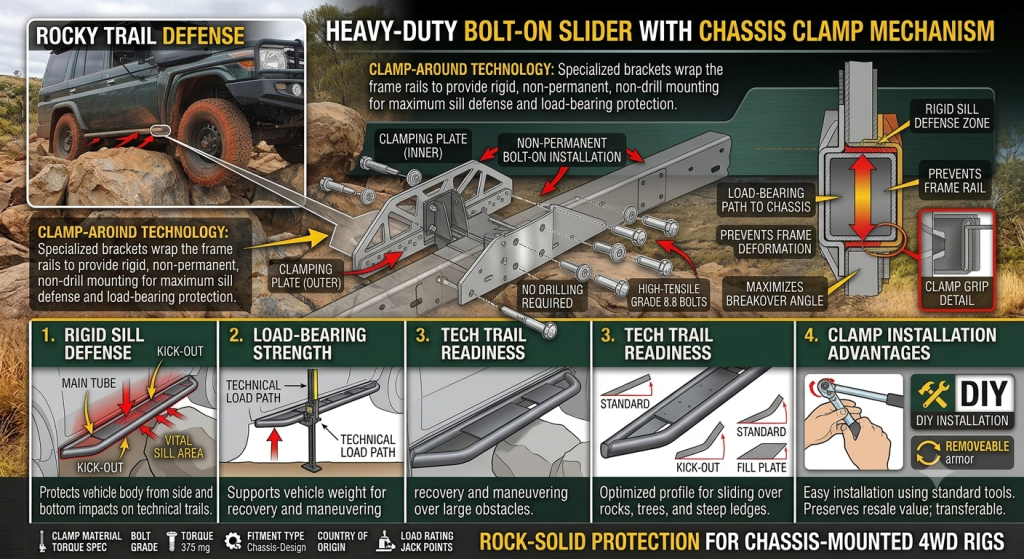
Equipping your utility truck or touring wagon with high-performance bolt on rock sliders 4wd protection is one of the most effective structural upgrades you can make to defend your lower vehicle sills against extreme trail damage. Driving across technical rocky terrain, deep washouts, and steep ledge climbs exposes the vulnerable sheet metal sills and lower door skins of your vehicle to direct impact. Installing a dedicated set of bolt on rock sliders 4wd creates a heavy-duty physical barrier along the vehicle’s frame, ensuring that when the undercarriage contacts boulders or tree stumps, the weight of the vehicle is supported safely by structural steel armor rather than fragile factory body panels.
For four-wheel drive enthusiasts evaluating lower body armor options, choosing heavy-duty bolt on rock sliders 4wd provides maximum chassis defense combined with straightforward installation and maintenance. Unlike welded armor systems that permanently modify chassis rails and can complicate vehicle compliance, engineered bolt on rock sliders 4wd clamp securely around the chassis frame using heavy-gauge backing sandwich plates and high-tensile fasteners. Understanding how a quality set of bolt on rock sliders 4wd distributes extreme impact loads across the frame allows 4WD owners to navigate demanding offroad tracks with complete structural confidence.
In this comprehensive technical guide, we analyze every mechanical aspect of bolt on rock sliders 4wd armor systems. From material selection and wall thickness specifications to chassis mounting geometry, side-curtain airbag compliance, and step-by-step installation protocols, this guide covers everything you need to know about bolt on rock sliders 4wd protection.
Understanding the underlying structural mechanics of bolt on rock sliders 4wd reveals why chassis-clamped protection outperforms both factory side steps and weld-on armor solutions for touring vehicles.
                   [ Structural Architecture: Bolt On Rock Sliders 4WD ]
                                             │
  ┌──────────────────────────────────────────┴──────────────────────────────────────────┐
  ▼                                                                                     ▼
[ Chassis-Clamped Bolt On Sliders ]                                   [ Body-Mounted Factory Steps ]
• Clamps securely around boxed chassis frame rails                     • Bolts into thin sheet metal inner sill panels
• Heavy-wall steel tubing (3.2mm – 4.0mm DOM/CHS)                     • Thin 1.5mm extruded aluminum alloy profile
• Supports 100% Gross Vehicle Mass (GVM) load                         • Supports human foot weight only (100–150 kg max)
• Removable for surface maintenance and rust protection               • Deforms upward into doors upon rock impact
The primary engineering goal of bolt on rock sliders 4wd systems is to transfer impact force away from thin door sills and channel it directly into the vehicle’s boxed steel chassis rails. A quality set of bolt on rock sliders 4wd uses heavy laser-cut steel sandwich plates that wrap around the top, outer, and bottom faces of the frame rails. High-tensile Grade 8.8 or Grade 10.9 bolts clamp the mounting plates tightly, creating a friction-locked bond that prevents movement during severe strikes.
This friction-clamp engineering allows bolt on rock sliders 4wd to support the full static and dynamic mass of the vehicle. When dropping off a rock ledge, your bolt on rock sliders 4wd allow the vehicle to glide smoothly over the obstacle while keeping door panels completely clear. Furthermore, because bolt on rocksliders 4wd do not require direct welding to the chassis frame, they preserve factory heat treatment, avoid frame embrittlement, and comply fully with modern vehicle modification standards.
Selecting the right set of bolt on rock sliders 4wd for your touring or rock-crawling rig requires inspecting specific construction details and structural features. Here are seven critical characteristics that define high-performance bolt on rock sliders 4wd:
Top-tier bolt on rock sliders 4wd are constructed using 3.2mm to 4.0mm wall thickness Drawn Over Mandrel (DOM) or Cold Structural (CHS) steel tubing. Seamless DOM steel in bolt on rock-sliders 4wd delivers maximum yield strength, resisting denting and structural bending when sliding over granite boulders.
A proper bolt on rock sliders 4wd mounting assembly utilizes thick 6mm to 8mm laser-cut steel backing plates that clamp around the frame rails. Full-wrapper plates on bolt on rock-sliders 4wd prevent point-loading stress and protect internal chassis brake lines and wire harnesses.
An engineered rear kick-out section on your bolt on rock sliders 4wd extends the outer rail wider in front of the rear tires. This angled design pushes the vehicle’s rear quarter panels and wheel arches away from trees and rock faces as you drive forward.
Modern four-wheel drives feature accelerometer sensors mounted along chassis rails. Certified bolt on rock sliders 4wd feature engineered crumple zones or bracket mounts that absorb broadside impact energy without delaying side-curtain airbag triggering.
Authentic bolt on rock sliders 4wd serve as certified lifting points for high-lift jacks during trail recoveries. Utilizing your bolt on rock sliders 4wd as jack anchors makes tire changes and track placement safer on uneven ground.
To resist stone chipping, mud accumulation, and road salt corrosion, high-grade bolt on rock-sliders 4wd undergo zinc electrostatic dip coating followed by a durable, UV-stable textured powder coat finish.
Hybrid bolt on rock sliders 4wd incorporate dimpled steel or laser-cut aluminum top tread plates. Choosing bolt on rock sliders 4wd with tread plates provides a safe, non-slip step surface for entering the cabin or accessing roof rack equipment.
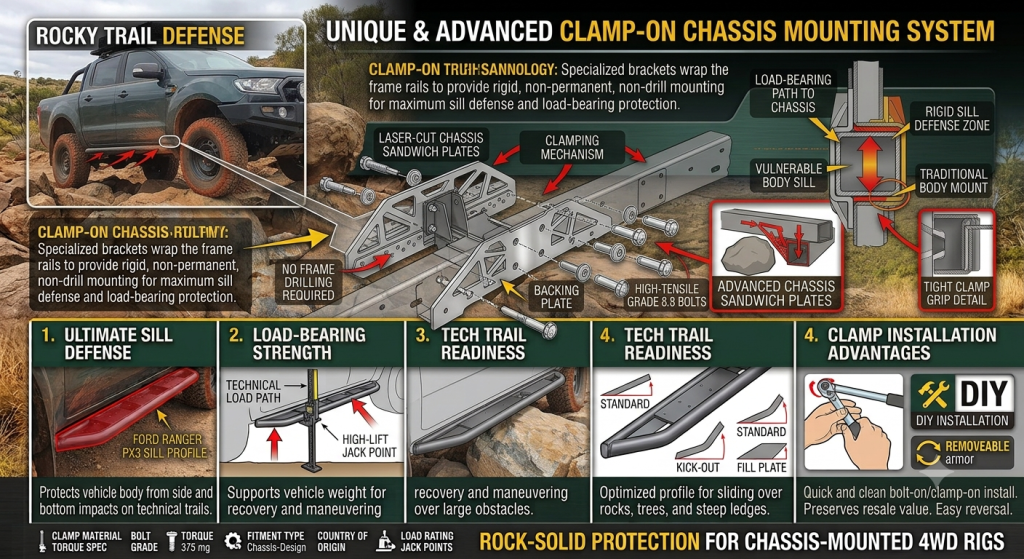
Figure 2: Laser-cut chassis sandwich plates and high-tensile Grade 8.8 bolts secure bolt on rock sliders 4wd tightly around chassis frame rails without frame drilling.
Comparing technical specifications helps buyers select the exact style of bolt on rock-sliders 4wd for their vehicle requirements:
| Specification / Feature | Heavy-Duty Tubular Sliders | Hybrid Step Sliders | Extreme Rock Crawling Sliders | Standard Factory Side Steps |
| Primary Material | 3.2mm DOM Steel Tubing | 3.2mm Steel + Tread Plate | 4.0mm Seamless DOM Steel | 1.5mm Extruded Aluminum |
| Mounting Architecture | Frame-Clamped Sandwich | Frame-Clamped Sandwich | Frame-Clamped Heavy Plate | Inner Sill Sheet Metal |
| Static Load Rating | 3,500+ kg (Full GVM) | 3,500+ kg (Full GVM) | 4,500+ kg (Extreme Load) | 120 kg (Foot Traffic Only) |
| Hi-Lift Jack Support | Full Support | Full Support | Full Support | Zero Support (Buckles) |
| Kick-Out Option | Available | Integrated Standard | Aggressive Wide Kick-Out | None |
| Step Usability | Narrow Tube Step | Wide Dimpled Tread Step | Flat Tube Step | Wide Flat Rubber Step |
| Offroad Protection | Extreme Rock Armor | High Rock & Sill Armor | Maximum Trail Armor | Gravel / Mud Shield Only |
Understanding material behavior is essential when evaluating bolt on rock sliders 4wd options for long-term durability.
                   [ Material Comparison for Rock Sliders ]
                                      │
  ┌───────────────────────────────────┼───────────────────────────────────┐
  ▼                                   ▼                                   ▼
[ DOM Seamless Steel Tubing ]   [ ERW Welded Steel Tubing ]    [ Structural Extruded Aluminum ]
• No seam line weakness         • Internal welded seam line    • Ultra-light weight penalty
• Uniform grain structure       • Economical manufacturing     • Non-rusting surface finish
• Maximum resistance to dents   • Moderate dent resistance     • Yields under severe impacts
Drawn Over Mandrel tubing is widely considered the ultimate material choice for bolt on rock-sliders 4wd. Because DOM steel is cold-drawn over a die and mandrel, it lacks a longitudinal weld seam. This uniform grain structure gives DOM bolt on rock sliders 4wd exceptional yield strength and torsional stiffness, allowing the outer rails to slide smoothly over jagged rock ledges without crushing or denting.
ERW steel tubing is produced by rolling flat steel plate and welding the seam along its length. While ERW steel is common in budget-friendly bolt on rock sliders 4wd, the weld seam represents a potential line of stress. High-quality ERW bolt on rock sliders 4wd with 3.2mm or 4.0mm wall thickness provide reliable sill defense for general touring and moderate track driving.
While aluminum alternatives exist, choosing aluminum over steel for bolt on rock-sliders 4wd involves balancing total vehicle weight against impact strength. Aluminum bolt on rock sliders 4wd reduce mass by roughly 20 kg to 25 kg across the set and offer rust resistance. However, under heavy boulder impacts, aluminum can gouge or deform, making steel bolt on rock sliders 4wd the top choice for demanding offroad tracks.
Installing a set of bolt on rock sliders 4wd requires proper tools, mechanical safety steps, and precise positioning around chassis wiring and fuel lines.
1.Inspect Frame Rails and Position Lifting Equipment:Verify chassis rail clearance around brake lines and wire looms.
Park your vehicle on level concrete. Inspect the chassis frame rails for brake lines, fuel lines, and electrical harnesses where bolt on rock sliders 4wd brackets will clamp.
2.Unclip Chassis Lines and Position Sandwich Backing Plates:Prevents damage to wiring looms and brake line brackets.
Unclip factory brake line retainers along the inner frame face. Slide the inner chassis sandwich plates for your bolt on rock sliders 4wd into position around the frame.
3.Align Rock Slider Assembly and Insert Fasteners:Use hydraulic trolley jacks to support heavy steel assemblies safely.
Lift the bolt on rock sliders 4wd unit using trolley jacks. Align bracket mounting holes with chassis backing plates and thread high-tensile Grade 8.8 bolts hand-tight.
4.Torque Hardware to Engineering Specifications:Ensures uniform clamping force without deforming chassis plates.
Align the slider rail parallel to the vehicle door sill, maintaining a 15mm clearance gap. Torque all clamp bolts on your bolt on rock sliders 4wd to specification using a torque wrench.
5.Perform Clearance Test and Door Alignment Verification:Confirms complete door clearance and step functionality.
Open and close all passenger doors to confirm complete clearance across your bolt on rock-sliders 4wd installation. Check that top step plates sit level.
explore our complete range of 4x4 armor, side steps, and rock sliders>
When installing bolt on rock-sliders 4wd, verifying compliance with national transport standards is essential. In Australia, vehicle modifications must adhere to regulations published by the Federal Register of Legislation under Australian Design Rules ADR 68/00 and ADR 72/00 (Occupant Protection and Side Impact).
                  [ ADR Safety Compliance Criteria ]
                                   │
   ┌───────────────────────────────┼───────────────────────────────┐
   ▼                               ▼                               ▼
[ Airbag Sensor Compatibility ]  [ Vehicle Projection Boundaries ] [ Pedestrian Projection Rules ]
• Must not alter crash pulse     • Outer rails must stay within   • Brackets must feature minimum
  timing for side-curtain airbags  factory fender flare width       2.5mm rounded edge radii
Offroad driving subjects bolt on rock sliders 4wd to constant mud, stone spray, and water crossings. Maintaining protective coatings ensures long-term defense against chassis corrosion.
High-quality bolt on rock sliders 4wd use a multi-layer coating system. The raw steel is shot-blasted to clean the surface, treated with a zinc phosphate bath, and coated with an electrostatic e-coat primer. Finally, a textured satin black powder coat is applied to shield your bolt on rock sliders 4wd against UV rays and stone abrasion.
Examining real-world applications highlights how different drivers configure bolt on rock-sliders 4wd systems for their specific touring environments:
Use this handy checklist when shopping for bolt on rock sliders 4wd armor:
Equipping your vehicle with high-grade bolt on rock sliders 4wd ensures total peace of mind, protecting lower body sills and chassis rails on every offroad adventure!