Ultimate Ford Ranger Winch Compatible Bull Bar Buyer Guide: Safety, Performance & Fitment
Ultimate Ford Ranger Winch Compatible Bull Bar Buyer Guide: Safety, Performance & Fitment
Upgrading your dual-cab utility with a heavy-duty ford ranger winch compatible bull bar is one of the most critical modifications you can perform when preparing for remote Australian touring, heavy work-site duties, or offroad trail exploration. Whether you drive a PX1, PX2, PX3, or the Next-Gen platform, fitting a certified ford ranger winch compatible bull bar provides essential physical protection for your radiator, intercooler, and engine bay against catastrophic animal strikes. More importantly, a dedicated ford ranger winch compatible bull bar supplies the structural foundation required to mount a high-capacity electric recovery winch safely.
However, selecting the right ford ranger winch compatible bull bar involves far more than picking a style that looks aggressive. Modern utilities are packed with complex technology, including Advanced Driver Assistance Systems (ADAS), millimeter-wave radar units, ultrasonic parking sensors, and sophisticated airbag deployment networks. Installing an unapproved front bumper can disable vital safety systems or render your vehicle completely unroadworthy.
This comprehensive guide breaks down everything you need to know before buying a ford ranger winch compatible bull bar, covering material physics, Australian Design Rules (ADR) compliance, Gross Vehicle Mass (GVM) impacts, suspension tuning, ADAS sensor integration, and step-by-step installation mechanics.
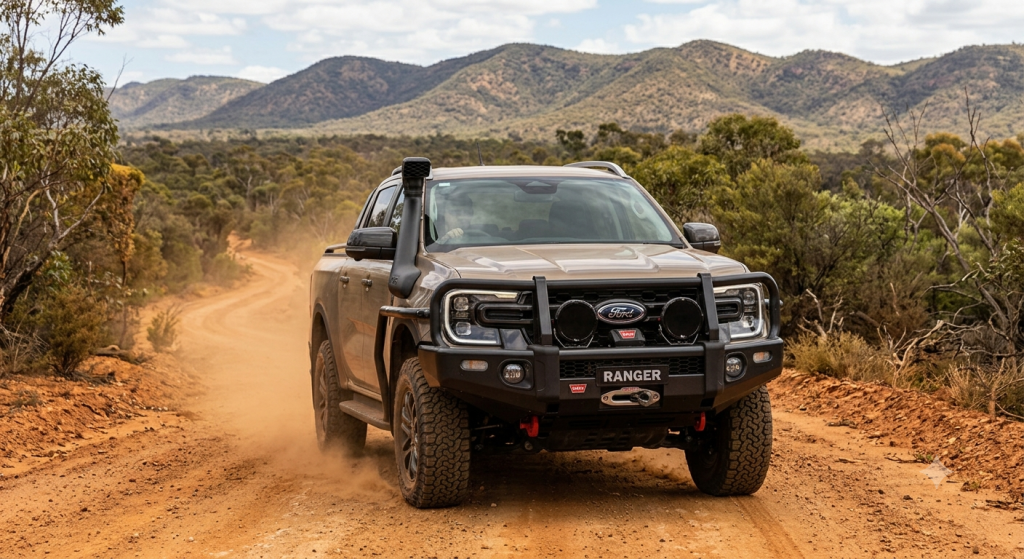
Choosing a certified ford ranger winch compatible bull bar protects critical engine components while maintaining full factory safety sensor operation.
1. Why Every Tourer Needs a Ford Ranger Winch Compatible Bull Bar
When traveling through regional and remote Australia, self-recovery capability and frontal protection are indispensable. Standard plastic factory bumpers are designed exclusively for low-speed urban impacts and aerodynamic efficiency—they offer zero protection against a 70 kg kangaroo at 100 km/h and possess no structural mounting capability for recovery winches.
Installing a high-performance ford ranger winch compatible bull bar solves both challenges simultaneously.
                      [ Ford Ranger Chassis Frame Rails ]
                                       │
                      [ Heavy-Duty Steel Mounting Cradle ]
                                       │
             ┌─────────────────────────┴─────────────────────────┐
             ▼                                                   ▼
[ Winch Housing & Fairlead ]                         [ Accordion Crumple Brackets ]
Rated for 9,500 lb–12,000 lb pulls                  Folds during crash impact to
without structural chassis twist                     trigger SRS airbags per ADR 69/73
The Engineering Behind Winch Compatibility
Not all aftermarket bull bars are engineered to house a recovery winch. A true ford ranger winch compatible bull bar incorporates a heavy-duty internal steel mounting cradle that bolts directly to the front chassis rails using high-tensile fasteners.
When executing a vehicle recovery using a 9,500 lb to 12,000 lb electric winch, immense directional kinetic forces are transferred directly to the mounting plate. A purpose-built ford ranger winch compatible bull bar distributes these loads evenly across both chassis rails. Installing a winch onto a standard non-winch-rated bar can rip the outer shell off its mounts, shear chassis bolts, or twist the vehicle frame permanently.
2. Platform Breakdown: PX Series vs. Next-Gen Ford Ranger
The engineering requirements for a ford ranger winch compatible bull bar vary depending on your vehicle’s specific generation and model series.
               [ Ford Ranger Generation Compatibility ]
                                  │
     ┌────────────────────────────┼────────────────────────────┐
     ▼                            ▼                            ▼
[ PX1 / PX2 Platforms ]     [ PX3 Platform (2018-2021) ]  [ Next-Gen Platform (2022+) ]
Central winch cradle;       Introduced central radar      Matrix LED compatibility;
standard lighting wire      housing; required radar cutouts 360 camera & radar integration
PX1 & PX2 Ford Ranger (2011 – 2018)
The early PX series features a traditional front fascia layout. Selecting a ford ranger winch compatible bull bar for these models is relatively straightforward:
Focuses primarily on physical fitment, radiator airflow, and fog light integration.
Uses direct chassis mount brackets that accommodate traditional 9,500 lb low-mount winches.
Requires basic wiring splices or plug-and-play looms for indicator and parking lights.
PX3 Ford Ranger (2018 – 2021)
With the launch of the PX3, Ford introduced autonomous emergency braking (AEB) and radar-based adaptive cruise control as standard features across higher trim levels.
A compatible ford ranger winch compatible bull bar must include a central radar housing box situated in the lower grille area.
The radar unit must sit behind an non-interfering acrylic window or within a dedicated laser-cut cutout to maintain factory sensor range.
Next-Gen Ford Ranger (2022+)
The Next-Gen Ranger architecture completely redesigned the front engine bay, introducing Matrix LED headlight options, front-facing 360-degree cameras, and complex ultrasonic sensor arrays.
Any ford ranger winch compatible bull bar designed for the Next-Gen platform must feature precise relocation mounts for all six front parking sensors.
The front camera housing must be re-positioned to maintain an unobstructed forward view without displaying the top of the bull bar hoop in the center touchscreen display.
Airflow dynamics are critical: the Next-Gen twin-turbo V6 and 2.0L Bi-Turbo engines generate higher cooling demands, requiring wide air intake channels built into the bar’s lower skirt.
“Looking to equip your rig for extreme outback travel? Explore ADR compliant winch bull bars for Ford Ranger designed for seamless factory sensor integration.”
3. Comprehensive Material Comparison: Steel vs. Aluminium vs. Polymer
Choosing the right construction material for your ford ranger winch compatible bull bar dictates its total weight, structural impact capacity, maintenance requirements, and long-term durability.
Feature / Metric
Structural Steel
Marine-Grade Aluminium
Advanced Polymer / SmartBar
Average Bare Bar Weight
55 kg – 85 kg
30 kg – 50 kg
25 kg – 40 kg
Complete Setup Weight (Bar + Winch)
90 kg – 125 kg
65 kg – 90 kg
60 kg – 80 kg
Tensile Strength
~400–500 MPa
~270–310 MPa
High Elastic Deformation
Winch Mounting System
Direct welded steel superstructure
Internal heavy-duty steel cradle
Internal heavy-duty steel cradle
High-Speed Impact Performance
Maximum (resists bending)
Moderate (absorbs medium impacts)
High (flexes and pops back)
Corrosion Resistance
Requires powder coating / E-coating
Excellent natural resistance
Impervious to rust and corrosion
Field Repairability
High (can be welded / pulled back)
Low (prone to stress cracking)
Non-repairable (rebounds naturally)
Front Suspension Upgrade Required?
Almost always mandatory
Recommended
Optional (depending on winch selection)
[INSERT IMAGE 2 HERE]
Suggested Visual: Detailed comparison graphic displaying a heavy-duty steel triple-hoop winch bar next to a sleek, stealth bumper-replacement alloy winch bar.
Alt Text:ford ranger winch compatible bull bar - steel vs alloy bull bar weight and impact comparison
Caption:Steel bars deliver maximum outback protection against severe animal strikes, while alloy options preserve payload and reduce front axle weight.
Deep Dive into Steel Options
For heavy outback touring, pastoral work, or high-density wildlife corridors, a steel ford ranger winch compatible bull bar remains the gold standard.
  [ Heavy Steel Bar High-Speed Impact Dynamics ]
                       │
  [ Large Animal / Obstacle Collision ] ──► [ Outer Steel Wings Resist Deformation ]
                                                       │
                                                       ▼
                                         [ Kinetic Energy Transferred ]
                                                       │
                                                       ▼
                                         [ Accordion Mounting Brackets ]
                                         [ Crumple to Trigger SRS Airbags ]
Maximum Structural Strength: Structural plate steel (typically 3mm to 5mm thick) resists severe bending under intense impact loads. If you strike a large animal at highway speeds, a steel ford ranger winch compatible bull bar keeps its structural shape, preventing the outer tubing from collapsing back into your headlights, radiator, or air intake lines.
Integrated Recovery Points: Heavy-duty steel bars feature welded recovery points rated for 4,000 kg to 5,000 kg snatch recoveries, passing forces directly into the chassis frame rails.
Rough Terrain Durability: Steel withstands scrub damage, rock scrapes, and continuous corrugation vibration without suffering metal fatigue cracks over extended touring trips.
Deep Dive into Aluminium (Alloy) Options
If preserving front payload and staying within legal weight limits is your primary concern, an aluminium ford ranger winch compatible bull bar provides an ideal alternative.
  [ Marine-Grade Alloy Construction ]
                  │
  ┌───────────────┴───────────────┐
  ▼                               ▼
[ 6mm Alloy Outer Shell ]   [ Internal Steel Cradle ]
Lightweight front profile   Handles 9,500lb–12,000lb winch
reduces front axle load     pulls without flexing
Weight Reduction: An alloy ford ranger winch compatible bull bar saves approximately 30 kg to 40 kg off the front axle compared to a full-steel equivalent.
Internal Steel Winch Cradle: To ensure high recovery performance, a quality alloy ford ranger winch compatible bull bar utilizes a hidden steel chassis cradle to handle winch forces, keeping load stress off the lighter aluminium outer shell.
Corrosion Resistance: Marine-grade aluminium (such as 5083 or 6061 alloy) naturally resists corrosion, making an alloy ford ranger winch compatible bull bar an excellent choice for coastal beach driving, boat launching, and high-humidity tropical environments.
One of the most frequently overlooked aspects of fitting a ford ranger winch compatible bull bar is calculating its impact on front axle weight and vehicle dynamics.
Understanding Front Axle Load Dynamics
The factory Ford Ranger front suspension utilizes an Independent Front Suspension (IFS) layout featuring coilover struts designed around factory spring rates. Every vehicle possesses a strict Gross Axle Weight Rating (GAWR) set by the manufacturer.
  Factory Ranger Front Tare Weight
+ Steel Winch Bull Bar (~75 kg)
+ 12,000 lb Electric Winch with Steel Cable (~38 kg)
+ Pair of 9-inch High-Output LED Spotlights (~7 kg)
+ Under-Bonnet Dual Battery System (~24 kg)
------------------------------------------------
= Total Added Front Axle Load: ~144 kg!
Adding nearly 150 kg directly over the front bumper dramatically alters the vehicle’s center of gravity and suspension geometry:
Ride Height Drop: Factory coil springs sag between 30mm and 50mm, severely reducing front ground clearance.
Suspension Bottoming: The front suspension constantly rides on or near its rubber bump stops, causing harsh ride quality over small bumps.
Braking Nose-Dive: Heavy front weight causes extreme forward weight transfer during emergency braking, increasing stopping distances and stability control interventions.
Accelerated Wear: Upper control arm ball joints, tie rod ends, and shock absorber valving suffer premature wear under continuous heavy loads.
                 [ Front Suspension Load Response ]
                                  │
    ┌─────────────────────────────┴─────────────────────────────┐
    ▼                                                           ▼
[ Factory Coil Springs ]                   [ Upgraded Heavy-Duty Coils ]
Sags 30mm–50mm under bar weight;           Maintains factory ride height;
bottoms out on bump stops                  restores full suspension compression travel
Recommended Suspension Upgrades
To ensure your vehicle handles safely after installing a heavy steel ford ranger winch compatible bull bar and recovery winch, you should upgrade your front suspension:
Upgraded Coils: Install raised, heavy-duty coil springs rated specifically for constant front loads (typically 50–100 kg or 100+ kg constant rating).
Matched Performance Struts: Upgrade to large-bore gas or foam-cell shock absorbers equipped with heavy-duty internal pistons to control dampening rebound.
Aftermarket Upper Control Arms (UCAs): If your front lift exceeds 40mm after fitting your ford ranger winch compatible bull bar, install upgraded UCAs to restore correct wheel alignment camber and caster settings.
[INTERNAL LINK CALLOUT 2]
Anchor Text:upgrade your Ford Ranger suspension and recovery gear
Context Sentence: “Preparing your ute for a heavy front steel winch bar? Upgrade your Ford Ranger suspension and recovery gear to maintain factory ride height and safe handling.”
5. Australian Design Rules (ADRs), Airbag Compliance & Legal Standards
Safety and road legality are non-negotiable when installing a ford ranger winch compatible bull bar on Australian roads. Fitting an illegal or non-compliant front bar can result in costly police fines, failed roadworthy inspections, and voided vehicle insurance coverage in the event of an accident.
Australian Design Rules (ADR 69/00 and ADR 73/00)
Under Australian federal legislation managed by the Department of Infrastructure Third Edition ADRs, all vehicles equipped with Supplementary Restraint Systems (SRS) airbags must undergo strict crash testing.
                                [ Crash Impact Event ]
                                           │
                                           ▼
            [ Certified Ford Ranger Winch Compatible Bull Bar ]
                                           │
            ┌──────────────────────────────┴──────────────────────────────┐
            ▼                                                             ▼
[ Accordion Mounting Brackets Fold ]                         [ SRS Airbag System Triggers ]
Absorbs kinetic impact energy                                Deploys within milliseconds
without delaying crash sensors                               to protect occupants per ADR 69
A fully compliant ford ranger winch compatible bull bar features precision-engineered accordion mounting brackets or crumple zones. During a severe collision, these steel brackets fold predictably at calculated load thresholds, transferring impact energy to the chassis frame rails and triggering the vehicle’s internal accelerometer crash sensors within milliseconds. An non-compliant bar that is overly rigid can delay airbag deployment, resulting in severe occupant injury.
Australian Standard AS 4876.1-2002
The national framework governing Vehicle Frontal Protection Systems (VFPS) is detailed in AS 4876.1-2002 guidelines. Essential regulatory requirements for your ford ranger winch compatible bull bar include:
Profile Contour Matching: The outer profile of the ford ranger winch compatible bull bar must conform to the general shape and width of the Ford Ranger front end. It must not extend wider than the vehicle’s side mirrors.
Forward Projection Offset: The bar must not project forward more than 75mm beyond the front profile of the vehicle mounting baseline.
Radiused Edges & Sharp Protrusions: All forward-facing edges, tubing corners, and light brackets must feature smooth, radiused edges (minimum 5mm radius) to minimize injury risks to pedestrians. Sharp forward projections, unshielded fishing rod holders, or exposed winch fairlead edges are strictly illegal under state standards such as Transport Victoria VSI 1 Bull Bars Guidelines.
Lighting Obstructing Rules: Your ford ranger winch compatible bull bar must not obscure the illumination angles of factory headlights, daytime running lights, or indicator lamps. If the bar structure blocks factory lights, it must feature integrated auxiliary indicators and park lights wired into the main loom.
Driver Sightline Clearance: The top tubing of a triple-hoop ford ranger winch compatible bull bar must sit below the driver’s forward sightline, ensuring unobstructed vision of the road surface 11 meters forward from the driver’s seating position.
A quality ford ranger winch compatible bull bar features a clean fairlead recess and dedicated cutouts for factory ADAS safety sensors.
6. Popular Style Profiles for Ford Ranger Winch Bars
Selecting the best style profile for your ford ranger winch compatible bull bar comes down to balancing maximum physical protection against offroad approach angles and visual aesthetics.
                [ Ford Ranger Bull Bar Style Profiles ]
                                   │
     ┌─────────────────────────────┼─────────────────────────────┐
     ▼                             ▼                             ▼
[ Triple Hoop Traditional ]   [ Single Hoop Commercial ]   [ Stealth Bumper Replacement ]
Full headlight & radiator     Sleek center hoop;           Ultra-high clearance;
protection; best for outback  great for general touring    ideal for offroad rock crawling
1. Traditional Triple Hoop Bull Bar
Best Suitable For: Remote outback touring, pastoral station work, and high-risk wildlife zones.
Design Layout: Features a large center hoop protecting the grille alongside two outer wing hoops shielding the headlight assemblies and front fenders.
Verdict: Delivers maximum physical coverage against animal strikes. A triple-hoop ford ranger winch compatible bull bar is the heaviest style option but offers unmatched structural protection for long-distance remote travelers.
2. Single Hoop / Center Loop Bull Bar
Best Suitable For: General touring, 4WD exploration, and daily commuting.
Design Layout: Incorporates a single central hoop protecting the main radiator and grille area, leaving the outer headlight wings open for a cleaner look.
Verdict: Provides excellent radiator protection while keeping overall weight down. Many dual-cab owners consider a single-hoop ford ranger winch compatible bull bar the perfect compromise between rugged protection and everyday style.
3. Stealth Bumper-Replacement (Hoopless) Bar
Best Suitable For: Technical offroad driving, rock crawling, and urban touring.
Design Layout: Completely removes the lower plastic factory bumper and replaces it with a low-profile steel skirt containing the winch cradle, leaving the upper grille exposed.
Verdict: Dramatically increases front approach angles (often increasing clearance from 28 degrees up to 34+ degrees). While a hoopless ford ranger winch compatible bull bar protects lower intercooler lines and houses a winch cleanly, it leaves upper bonnet and headlight areas exposed to tall animal impacts.
7. Selecting and Mounting the Ideal Recovery Winch
Buying a ford ranger winch compatible bull bar is only half the equation—you must also choose a compatible electric recovery winch that fits inside the bar’s internal cradle.
                  [ Winch Selection Parameters ]
                                 │
     ┌───────────────────────────┴───────────────────────────┐
     ▼                                                       ▼
[ Synthetic Rope Option ]                               [ Steel Cable Option ]
• Saves ~10kg off front axle                            • High abrasion resistance against rocks
• Safe to handle; stores less kinetic energy            • Heavier weight; requires dampener blanket
• Requires UV protection & fairlead polish              • Low maintenance; resists UV degradation
Winch Sizing Formula for the Ford Ranger
To ensure your winch can pull a fully loaded dual-cab ute out of deep mud or sand, calculate your minimum winch capacity using this standard industry formula:
$$\text{Minimum Winch Capacity} = \text{Gross Vehicle Mass (GVM)} \times 1.5$$
For a Ford Ranger with a typical 3,200 kg GVM rating:
Therefore, a 9,500 lb to 12,000 lb electric winch is the ideal rating for any ford ranger winch compatible bull bar setup.
Synthetic Rope vs. Steel Cable
When outfitting your ford ranger winch compatible bull bar, choosing between synthetic rope and traditional steel cable significantly impacts front-end weight and safety:
Synthetic Rope: Saves between 8 kg and 12 kg off the front bumper, does not store dangerous kinetic energy under load, and is easy to handle. It requires an aluminium hawse fairlead mounted cleanly to your ford ranger winch compatible bull bar.
Steel Cable: Highly resistant to sharp rock abrasion and mud grinding, but adds substantial weight to your front axle and requires a roller fairlead.
Installing a ford ranger winch compatible bull bar requires mechanical competence, specialized tools, and precise handling of vehicle electrical systems. Below is an overview of the installation workflow.
Tools and Equipment Required
Standard metric socket and spanner set (10mm through 24mm)
High-tensile torque wrench (rated up to 200 Nm)
Reciprocating saw or angle grinder (for bumper trimming models)
Masking tape and protective eye wear
Automotive trim removal tools
Multimeter and soldering iron / heat-shrink connectors for electrical looms
[ Step 1: Disconnect Battery & Remove Grille ]
                      │
                      ▼
[ Step 2: Trim Factory Bumper Using Template ]
                      │
                      ▼
[ Step 3: Install Heavy Steel Chassis Cradle ]
                      │
                      ▼
[ Step 4: Mount Winch & Route Power Cables ]
                      │
                      ▼
[ Step 5: Transfer ADAS Radar & Parking Sensors ]
                      │
                      ▼
[ Step 6: Bolt Bull Bar Shell & Torque Hardware ]
                      │
                      ▼
[ Step 7: Test ADAS Safety Sensors & Lighting ]
Step-by-Step Installation Workflow
Step 1: Vehicle Preparation & Safety
Disconnect the vehicle’s dual negative battery terminals and wait 15 minutes before uncoupling any wiring looms. This prevents accidental fault codes or SRS airbag system errors while working near crash sensors.
Step 2: Front Fascia Disassembly & Bumper Trimming
Carefully unclip the front plastic grille and radiator shroud using automotive trim tools. If your chosen ford ranger winch compatible bull bar requires a bumper cut, apply wide masking tape along the factory bumper. Mark the exact cut line using the manufacturer’s paper template and trim cleanly using a reciprocating saw.
Step 3: Fitting the Main Chassis Cradle
Unbolt the factory crash beam and tow hooks from the front frame rails. Position the heavy-duty steel mounting cradle supplied with your ford ranger winch compatible bull bar against the chassis rails. Insert high-tensile Grade 8.8 bolts along with sliding chassis nut-plates. Keep fasteners finger-tight at this stage to allow final adjustments.
Step 4: Winch Installation
Before mounting the main outer bull bar shell, bolt your electric winch into the steel cradle. Route the positive and negative heavy-gauge power cables up through the engine bay toward the battery, securing them away from moving belts or hot exhaust components using high-temperature protective conduit.
Step 5: Relocating ADAS Radar & Parking Sensors
Unclip the factory parking sensors from the plastic bumper and transfer them into the rubber isolation grommets built into your new ford ranger winch compatible bull bar. If your Ranger features a radar unit, unbolt it from its factory location and mount it securely into the bar’s central radar housing box.
Step 6: Mounting and Aligning the Outer Shell
With assistance or a mechanical crane, lift the outer shell of the ford ranger winch compatible bull bar over the chassis cradle. Align the side mounting holes and insert the retaining bolts. Adjust the gap between the top edge of the bull bar and the vehicle’s bodywork (maintain a consistent 15mm to 20mm clearance gap to allow for engine chassis flex when driving offroad).
Step 7: Final Torquing & Electrical Testing
Torque all mounting bolts to the manufacturer’s exact Newton-meter specifications. Reconnect the battery terminals and verify that all fog lights, auxiliary indicators, parking sensors, adaptive cruise control functions, and winch hand-controllers operate without throwing fault codes on the instrument cluster.
Even the highest quality ford ranger winch compatible bull bar requires routine care and maintenance to ensure it remains safe and visually appealing.
Maintenance Checklist for Steel Winch Bars
Stone Chip Repairs: Gravel roads chip away protective outer coatings. Inspect your ford ranger winch compatible bull bar after every offroad trip and touch up bare steel patches immediately using satin black automotive paint to stop rust before it spreads.
Chassis Hardware Re-Torquing: Continuous corrugations can loosen mounting bolts over time. Re-torque all chassis mounting bolts every 10,000 km or immediately following a major outback expedition.
Cleaning & Degreasing: Wash away accumulated mud, road grime, and insect residue using pH-neutral car wash soap. Avoid harsh caustic cleaners that dull powder-coated surfaces.
Maintenance Checklist for Alloy Winch Bars
Oxidation Polishing: Uncoated aluminium bars require regular treatment with specialized metal polish to eliminate oxidation and maintain a bright mirror finish.
Salt Spray Rinsing: After driving through coastal surf or sandy beaches, flush the internal channels of your aluminium ford ranger winch compatible bull bar with fresh water to remove trapped salt brine and prevent galvanic corrosion around steel chassis bolts.
Maintenance Checklist for Your Integrated Winch
Monthly Cable Spooling: Unspool and neatly respool your winch rope under light tension once every month to prevent binding and keep internal drum mechanisms lubricated.
Electrical Connection Check: Inspect the primary power terminals connected to your battery and winch solenoid box for green copper corrosion or loose hardware.
Investing in a certified ford ranger winch compatible bull bar is one of the smartest upgrades you can make to your 4WD. By choosing a bar that balances physical protection, material weight, ADR compliance, and seamless ADAS sensor compatibility, you ensure your Ford Ranger remains legal, safe, and ready for any challenge the Australian outback presents.
Pairing your ford ranger winch compatible bull bar with an appropriately rated electric winch and heavy-duty front coil springs creates a robust touring setup designed to handle high-speed animal strikes and remote offroad recoveries with complete confidence.
Have questions about fitment compatibility, winch sizing, or suspension payload calculations for your Ford Ranger? Contact our expert technical team at All Model 4×4 Spares. We are dedicated to helping you choose a fully compliant, high-performance protection setup tailored specifically to your vehicle!