Nudge Bar vs Bull Bar: Which One Does Your Ute Need?
When setting up a dual-cab ute or 4WD wagon for Australian conditions, deciding between a nudge bar vs bull bar is one of the most common upfront decisions. While both front accessories change the look of your vehicle and provide light-to-heavy impact defense, they are engineered for vastly different environments, collision types, and load-bearing requirements.
Choosing the wrong front setup can lead to unnecessary weight on your front suspension, compromised ground clearance, or inadequate protection against high-speed animal strikes in rural areas.
This ultimate nudge bar vs bull bar comparison breaks down structural differences, protection levels, weight impacts, ADAS safety sensor integration, and pricing to help you choose the right front bar for your ute.
1. Quick Overview: Nudge Bar vs Bull Bar at a Glance
Before examining technical details, reviewing a high-level nudge bar vs bull bar comparison helps identify which design matches your vehicle’s primary driving conditions:
Feature / Metric
Nudge Bar
Bull Bar
Primary Protection
Low-speed parking impacts, light brush, city bumps
High-speed wildlife collisions (kangaroos/livestock), heavy offroad ruts
Coverage Area
Lower central radiator area only
Full front fascia (grille, headlights, and front wings)
Material & Construction
Lightweight polished aluminum tubing or light steel
Heavy-duty structural steel, thick alloy plate, or polymer
Weight Added
10 kg – 20 kg
45 kg – 85 kg
Suspension Upgrade Needed?
No
Highly recommended (heavy-duty front coils/struts)
Winch Compatible?
No
Yes (on winch-rated commercial and offroad models)
To make an informed nudge bar vs bull bar choice, it helps to look at how a nudge bar is constructed and where it performs best.
                    [ Nudge Bar Architecture ]
                                 │
     ┌───────────────────────────┼───────────────────────────┐
     ▼                           ▼                           ▼
[ Light Aluminum Tubing ]   [ Direct Bumper Fitment ]   [ Auxiliary Light Mounts ]
76mm to 100mm tubular       Attaches via lower subframe  Pre-drilled mounting tabs
profile protecting lower     brackets without replacing   for slim LED light bars or
radiator stack               factory plastic bumper      small driving lights
A nudge bar is a lightweight, low-profile front accessory usually made from 76mm to 100mm polished aluminum or powder-coated steel tubing. It mounts to the vehicle’s lower chassis crossmember and sits directly in front of the factory bumper.
Key Pros of a Nudge Bar:
Minimal Weight: Weighing only 10kg to 20kg, a nudge bar does not cause front-end suspension droop or reduce payload capacity.
Cost-Effective: Purchase and fitting prices are significantly lower than a full front bar replacement.
Suburban Protection: Shields front plastics against shopping trolley dings, minor parking bay taps, and light bush scrubbing.
Light Mounting: Offers built-in tabs for mounting driving lights, a small LED light bar, or a UHF antenna.
Key Cons of a Nudge Bar:
No Wildlife Defense: A nudge bar will fold back into the radiator and grille upon high-speed impact with a kangaroo or livestock.
No Winch Capability: It cannot support an internal recovery winch cradle.
Limited Coverage: Leaves headlights and outer front quarter panels fully exposed.
3. What Is a Bull Bar?
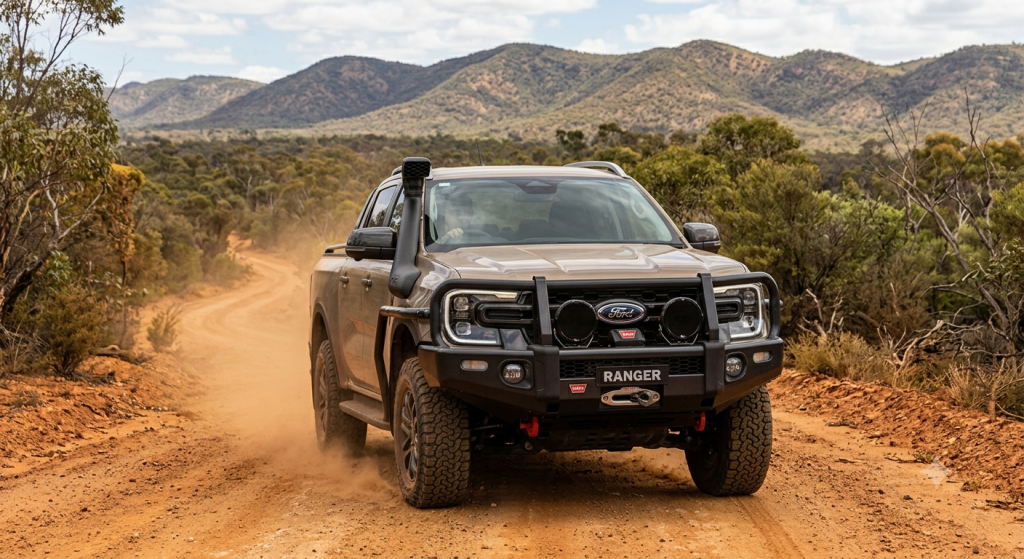
When evaluating a nudge bar vs bull bar for remote driving, a bull bar serves as a comprehensive front protection system that replaces or heavily trims the vehicle’s factory bumper assembly.
                    [ Bull Bar Architecture ]
                                 │
     ┌───────────────────────────┼───────────────────────────┐
     ▼                           ▼                           ▼
[ Structural Steel/Alloy Shell ] [ Chassis Mount & Crumple Zone ] [ Winch & Recovery Rated ]
Full-width wing coverage for     Engineered accordion brackets   Internal steel winch cradle with
grille, headlights, & cooling    designed for ADR airbag compliance rated recovery points built in
Built from thick folded steel plate, structural alloy, or resilient polyethylene, a bull bar attaches directly to the main chassis rails to absorb severe kinetic energy.
Key Pros of a Bull Bar:
Maximum Strike Protection: Absorbs high-speed animal strikes, keeping the radiator intact so you aren’t stranded in remote outback locations.
Winch & Recovery Compatibility: Features integrated winch cradles and heavy-duty rated recovery points for safe vehicle extraction.
Improved Offroad Geometry: High-clearance offroad bull bars sweep upward at the wings to increase front approach angles over steep trail obstacles.
Complete Accessory Mounting: Accommodates large LED spotlights, dual UHF aerials, sand flags, and winches.
Key Cons of a Bull Bar:
Significant Weight: Adds 45kg to 85kg ahead of the front axle, requiring heavy-duty front coil springs or suspension upgrades.
Higher Total Investment: Higher purchase price and longer workshop fitting times (especially on ADAS-equipped utes).
4. Key Comparisons: Nudge Bar vs Bull Bar
Evaluating a nudge bar vs bull bar across real-world performance factors makes it clear which option fits your vehicle’s usage pattern.
1. Animal Strike Protection & Outback Safety
If you regularly travel country highways at dawn, dusk, or night, evaluating a nudge bar vs bull bar comes down to catastrophic impact survival:
                      [ Animal Impact Comparison ]
                                   │
     ┌─────────────────────────────┴─────────────────────────────┐
     ▼                                                           ▼
[ Nudge Bar Strike Event ]                       [ Bull Bar Strike Event ]
• Lightweight tubing deforms under high mass      • Full steel/alloy frame deflects impact
• Pushes into factory grille & radiator stack      • Protects cooling system, engine bay & lights
• Result: Severe radiator damage / stranded 4WD   • Result: Vehicle remains drivable to reach safety
A full steel or alloy bull bar preserves the engine’s cooling system during a kangaroo or livestock strike. A nudge bar is designed only for minor low-speed bumps and will not prevent radiator compromise during a rural highway impact.
Weight distribution plays a critical role in any nudge bar vs bull bar decision:
Nudge Bar: Adds minimal mass (10–20kg). It preserves factory suspension geometry, fuel economy, and available payload capacity without requiring vehicle modifications.
Bull Bar: Steel models add substantial front mass (55–85kg). This alters front axle weight distribution, causes front-end sag, and usually requires upgrading front strut coils to maintain correct ride height.
3. Safety Standards & ADAS Compatibility
Both front systems must meet Australian safety standards when fitted to modern vehicles.
Under federal rules managed by the Department of Infrastructure Third Edition ADRs, both nudge bars and bull bars fitted to airbag-equipped vehicles must comply with SRS airbag timing rules (ADR 69/00 and ADR 73/00).
Furthermore, front protection designs are governed by Standards Australia AS 4876.1, ensuring smooth outer radii (minimum 5mm) and preventing dangerous forward projections. Modern nudge bars and bull bars also feature precision cutouts and bracketry to preserve factory Autonomous Emergency Braking (AEB) radar units and parking sensors.
5. Decision Matrix: Nudge Bar vs Bull Bar
Use this practical decision flow to select between a nudge bar vs bull bar based on your driving habits and budget:
                  [ Where Do You Drive Your Ute Most Often? ]
                                       │
           ┌───────────────────────────┴───────────────────────────┐
           ▼                                                       ▼
[ Metro Cities, Highways & Light Dirt ]                 [ Remote Regional Roads & Rough Trails ]
           │                                                       │
           ▼                                                       ▼
• Drives mainly on suburban streets & highways         • Travels rural corridors with high kangaroo counts
• Seeking nudge protection in parking bays            • Needs winching capability & recovery points
• Wants low weight without suspension work             • Requires maximum ground clearance & protection
           │                                                       │
           ▼                                                       ▼
   [ CHOOSE A NUDGE BAR ]                                 [ CHOOSE A BULL BAR ]
Choose a Nudge Bar if:
Your ute is primarily driven in suburban, metro, or urban environments.
You only need light protection against parking taps and minor scrub.
You want an affordable spot to mount an LED light bar or UHF aerial.
You prefer to avoid upgrading your front suspension or adding heavy front-end mass.
Choose a Bull Bar if:
You tour regional highways, outback tracks, or agricultural areas where wildlife collisions are common.
You need to mount a 4WD recovery winch and use rated recovery points.
You take on steep, technical offroad tracks requiring maximum approach angles.
You want full-width protection across your entire front end, including headlights and cooling systems.
6. Summary: Selecting the Ideal Setup for Your Ute
In the nudge bar vs bull bar debate, neither option is universally better—the right choice comes down to your driving environment, protection needs, and vehicle budget.
A nudge bar offers a lightweight, cost-effective solution for city drivers who want basic bumper protection and an easy spot to mount driving lights.
A bull bar delivers heavy-duty protection, winch integration, and outback defense for drivers venturing onto country highways and rugged offroad tracks.
Need Expert Advice on Front Protection Fitment?
Still deciding between a nudge bar or bull bar for your vehicle? Contact our technical team at All Model 4×4 Spares for professional advice on choosing, purchasing, and fitting the right front protection gear!